Get Full Government Meeting Transcripts, Videos, & Alerts Forever!
Get email alerts on the Downtown Development topic
No spam. Unsubscribe anytime.
Planning commission recommends 10‑story Albert Avenue project despite downtown parking concerns
Summary
The East Lansing Planning Commission recommended that city council approve a 10‑story mixed‑use development at 530 Albert Avenue using a LEED Gold incentive for two bonus stories, while commissioners and downtown business owners raised repeated concerns that the project eliminates roughly 80–90 public parking spaces; a separate parking‑plan public hearing is scheduled for July 22.
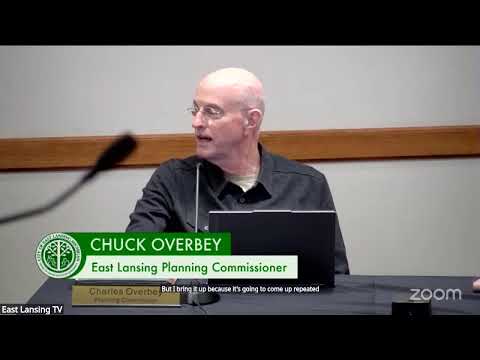
The East Lansing Planning Commission on June 24 recommended that City Council approve a site plan for a 10‑story mixed‑use building at 530 Albert Avenue, advancing the project to council for a July 21 vote while setting conditions that include confirmation of LEED Gold certification and Transportation Commission approval for temporary loading stalls on Albert Avenue.
The motion, moved by Commissioner Ramirez Roberts and seconded by Commissioner Chapen, finds the proposal consistent with the city’s zoning and the comprehensive master plan and attaches conditions including that staff review and confirm LEED Gold pre‑certification prior to the council vote and that the additional incentive stories not be occupied until the certification is confirmed. The commission’s recommendation passed by roll call.
The proposal drew sustained opposition from downtown business owners and residents at public comment, who said the project would remove about 80–90 spaces from the Bailey Street/Albert Avenue public parking area and provide no on‑site parking for the building. “The 530 Albert Avenue development as proposed without parking will damage not only the existing businesses in [the] 500 block and beyond, but will work against the continued fostering of a diverse, equitable, and inclusive downtown,” said Al Bay, who identified himself as owner of the Wild Goose Inn at 512 Albert Avenue.
Staff explained the zoning context repeatedly during the meeting: the B3 City Center district prohibits on‑site parking, so the applicant did not request on‑site parking. “Parking is prohibited,” planning staff said, adding that the applicant has proposed 10 temporary loading and short‑term stalls on Albert Avenue (15‑minute stalls that would transition to meters) and that staff will evaluate whether a separate parking plan is required under section 50‑593. If a parking plan is required, staff has scheduled a public hearing for July 22 to review that plan.
The applicant, Cody Dietrich of TDP Acquisitions (doing business as Train Development Partners), told the commission the team provided additional materials on geothermal systems and recycling/trash plans requested at an earlier meeting and said the project remains zoning‑compliant. Dietrich and the applicant’s attorney said Ingham County is the permitting authority for geothermal wells and that they will coordinate county permitting and share documentation with the city. “We’re not going to hide anything,” Dietrich said, describing a baseline assessment and a decontamination plan in case subsurface contamination is encountered.
Commissioners pressed multiple technical and policy questions: whether the LEED bonus for height was contingent solely on geothermal installation (staff said the project had sufficient points for LEED Gold even without geothermal but that geothermal is one path to points), what safeguards the county would require for closed‑loop geothermal wells, and how sequencing works if council conditions approval on a later parking‑plan decision. Staff explained that the parking plan is a separate public hearing and that city council can condition its action on planning commission approval of that plan; if council conditions approval on a parking plan that later fails at the planning commission hearing, the approvals could be affected.
The commission’s recommended conditions included standard engineering, landscaping and stormwater approvals, a 10‑foot landscaped setback on the western property line, Transportation Commission signoff for the proposed Albert Avenue loading area, and confirmation of LEED Gold pre‑certification prior to city council action. The project will appear before City Council on July 21; the city has scheduled a public hearing on any required parking plan for July 22.
Supporters argued the project advances the city’s comprehensive plan goal of concentrating higher‑density housing near Michigan State University and downtown, while opponents warned of short‑term and lasting harm to small businesses from reduced parking supply. The planning commission’s action forwards the technical site‑plan approvals while leaving the unresolved parking disputes to the July 22 parking hearing and the council review.