Get Full Government Meeting Transcripts, Videos, & Alerts Forever!
Get email alerts on the Science Of Reading Overview topic
No spam. Unsubscribe anytime.
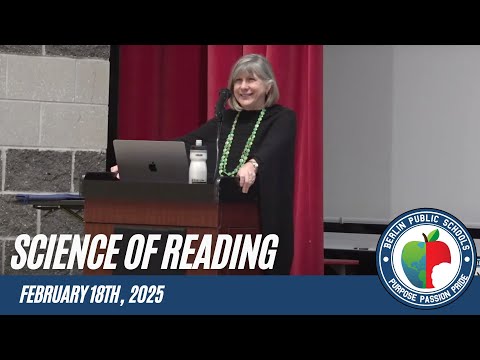
Trainer Lori Kuso summarizes ‘Science of Reading’ research, classroom examples and brain evidence
Summary
At a Berlin School District workshop, Lori Kuso reviewed decades of reading research, explained models such as the Simple View and Scarborough’s Reading Rope, and illustrated how structured literacy and decodable texts can create neural automaticity for reading.
Lori Kuso, an accredited training fellow with the Orton-Gillingham Academy, told Berlin School District staff that decades of research support targeted, systematic instruction in foundational reading skills alongside comprehension instruction.
"We are not hardwired to read," Kuso said, describing how the brain repurposes oral-language circuitry to map sounds to written symbols. She explained that orthographic mapping and repeated, multisensory practice are central to building automatic word recognition.
Kuso walked staff through two widely used frameworks: the Simple View of Reading (word recognition multiplied by language comprehension) and Scarborough’s Reading Rope, which depicts multiple strands—phonological awareness, decoding, vocabulary, background knowledge—that must be woven together over time. She emphasized that both structured literacy and balanced, authentic reading experiences have roles in instruction.
The trainer cited national assessment snapshots to underline the urgency for early intervention. She summarized findings from NAEP and other sources showing declines or plateaus in reading proficiency at several grade levels and argued that early, evidence-based instruction reduces long-term reading problems.
Kuso also addressed common neuromyths, saying claims like strict left/right brain division or simple 'learning styles' should not drive instruction. She stressed the importance of progress monitoring, diagnostic assessment and selecting texts with appropriate decodability for students’ skill levels.
Her classroom examples included multi-year implementation in a small Massachusetts district and a community-based reading clinic where students who began well below grade level made substantial gains with structured approaches. Kuso closed by pointing participants to resources saved in a shared drive and offering follow-up support as schools implement changes.