Get Full Government Meeting Transcripts, Videos, & Alerts Forever!
Get email alerts on the School Facilities topic
No spam. Unsubscribe anytime.
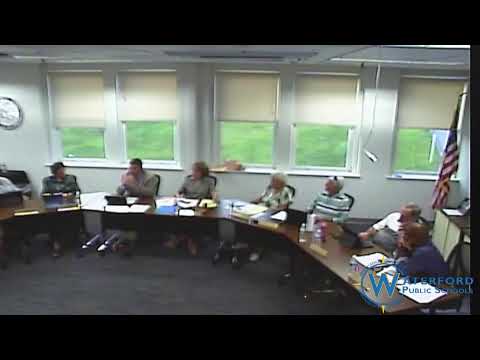
Waterford board hears consultant: Great Neck field likely needs rebuild; board authorizes seeking town funds
Summary
After a consultant reported severe soil compaction and drainage problems at Great Neck Elementary, the Waterford Board of Education authorized administrators to seek town funding for remediation and discussed short‑term fixes to get students back on playable turf.
At a Waterford Board of Education meeting, members heard a consultant present a field assessment for Great Neck Elementary and authorized administrators to seek town funding to remediate what the consultant called a failing soil profile that holds water and resists drainage.
Kevin D., sustainability adviser with Irwin Advisers, told the board the field’s soil tests showed very high fine‑material content and low aeration porosity, meaning the surface holds water rather than shedding it. “If you really want to fix the problem…our recommendation is to remove the surface material, import a proper root zone, add a sand shim layer and regrade,” Kevin said, summarizing the firm’s permanent‑repair recommendation.
The consultant gave specific measurements used to justify that recommendation: a reported volumetric water content near 34 percent in sample points, fine‑material fraction above 60 percent in the profile, compaction penetrometer readings in the field center (three test points reported as 456, 307 and 326 psi at depth), and Gmax hardness averages around 61 with bare areas reaching 125 — numbers the consultant said indicated both poor infiltration and uneven surface risk for use.
Kevin presented several mitigation options. Short‑term treatments such as core aeration, topdressing and overseeding can make portions of the field playable for a limited period but would require recurring work. Deep tine aeration can fracture deeper compaction but is likewise temporary unless the soil is re‑engineered. He strongly recommended adding irrigation as a near‑essential component for any seeding or rehabilitation plan in Connecticut, where chemical options are limited.
On costs, the consultant and the board discussed a wide range: lab and basic testing reported to be roughly $5,000; a consultant’s estimate for a full rebuild compiled from recent local projects was roughly $291,000 (the presenter recommended adding 10–20 percent contingency); short‑term mitigation to make part of the field playable was estimated in the $5,000–$10,000 range; sod for the entire field was discussed at an estimated installed cost approaching $200,000. Board members noted the final cost would depend on scope, permitting, and competitive bids.
Board members and administrators also discussed the municipal approval steps required for a major project: site‑plan review, possible Conservation Commission review, budget designation vs. appropriation steps with selectmen and finance boards, and competitive bidding. Those procedural steps could extend the timeline: the board and consultant said the full project timeline from approvals to completion could take about a year, while a short‑term mitigation project could be done in days to weeks and may cost roughly $7,000–$10,000 for limited, temporary playability.
After discussing short‑term options and seeking further cost and capacity information from Recreation & Parks, the board voted on a motion authorizing the administration to request an appropriation from the Town of Waterford’s undesignated fund balance to fund Great Neck field remediation. The transcript records the chair calling for “all in favor”; individual board member votes were not recorded in the transcript.
The board directed administrators to return with clearer cost options and to coordinate next steps with Recreation & Parks and town staff. Several members urged prompt action on a limited short‑term fix to allow children some play space while the long‑term project proceeds.
The board’s immediate next action will be to gather the additional price and schedule details requested and report back at the next meeting; the transcript notes no further action until the Sept. 2 meeting.