Get Full Government Meeting Transcripts, Videos, & Alerts Forever!
Get email alerts on the Zoning Text Amendment topic
No spam. Unsubscribe anytime.
Natrona planning commission approves new “outbuildings” zoning language, sets five-acre minimum
Summary
The Natrona County Planning Commission approved staff-recommended text changes to TA 26-01 that create a new outbuildings definition (4.08.15), remove “warehousing” from the wholesale distribution section, set a five-acre minimum and shift some reviews to conditional use, after staff explained how building codes affect height limits. Public comment was none.
The Natrona County Planning Commission voted April 14 to approve a staff-recommended zoning text amendment (TA 26-01) that creates a new definition for “outbuildings,” retains warehousing under wholesale distribution and storage, and sets a five-acre minimum for outbuildings in rural zones with conditional-use review for certain parcels.
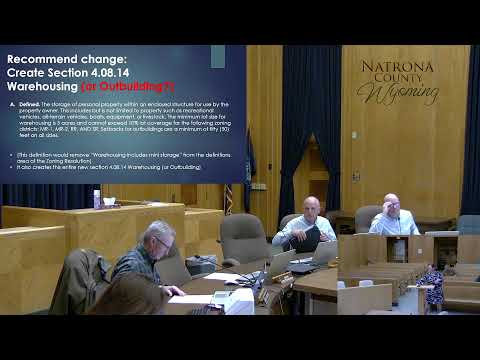
The change, presented by Development Director Sabrina Kemper, removes the term “warehousing” from section 4.08.14 and adds a new section 4.08.15 to define outbuildings as primarily personal-use structures. Kemper said the amendment would exclude mini-storage from the new outbuilding definition and instead leave mini-storage under wholesale distribution and storage. “We would take out the mini storage,” Kemper said during her staff report.
Kemper told commissioners the amendment reflects earlier feedback and several specific adjustments: increasing the minimum lot size from two acres to five acres for outbuildings, limiting lot coverage to 10% in MR1, MR2, RR and SR zones, and applying a 50-foot setback on all sides. She also said staff changed permitting in some zones—making uses conditional in MR1, MR2 and SR—because lot sizes vary across those districts.
Commissioners asked how structure heights would be controlled if outbuildings are permitted as a primary use on a vacant five-acre parcel. Natrona County Building Official Brad Morrison said building-code distinctions, not zoning, largely govern height: the International Residential Code covers one- and two-family dwellings up to three stories while the International Building Code applies for other uses and focuses on life-safety and fire-safety requirements. “The IBC allows whatever you want to do as long as you’re meeting those requirements,” Morrison said, adding that sprinkler requirements and water availability in unincorporated areas often limit very large or multi-story structures in practice.
Commissioners debated whether to use a zoning certificate (staff-level review) or a conditional-use permit (public hearings before the commission and the Board of County Commissioners) for certain rural residential cases. Several commissioners favored starting with the five-acre minimum and using the conditional-use route where neighbors or unusual circumstances warrant more review. Kemper said a conditional-use permit typically takes three to four months, including a pre-application conference and referrals to county departments and outside agencies.
The commission opened a public hearing on TA 26-01 and solicited comments in favor and opposition; no members of the public spoke. After discussion, a commissioner moved to approve the staff-recommended changes “as presented by the staff.” A second was recorded and the motion passed by voice vote.
The commission thanked staff for the work on the amendment and closed the public hearing. Staff said three cases are scheduled for the commission’s May 12 meeting. The Board of County Commissioners will hold a subsequent public hearing on TA 26-01 before any final county action, because the planning commission’s role is advisory.