Get Full Government Meeting Transcripts, Videos, & Alerts Forever!
Get email alerts on the Vista 2040 topic
No spam. Unsubscribe anytime.
Staff previews Vista 2040 general plan; stresses it won’t raise taxes, will go to voters
Summary
Planning staff presented the Vista 2040 general plan ahead of a Thursday public hearing, saying the plan sets policy direction but does not change zoning or raise taxes; staff highlighted modest projected growth, outreach metrics and next steps for voter information.
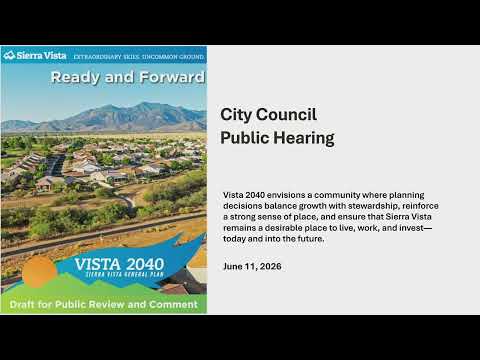
Planning staff on Monday summarized Vista 2040, a rewritten general plan the city will put before voters after a formal council adoption and a public hearing this week. Mr. Mclofflin, the planning staff presenter, told the council the document is primarily a policy framework and “the general plan sets direction, but it does not build projects. It is not a construction plan. It is not a budget. It does not change zoning, and it does not approve development projects.”
The presentation emphasized that the plan will be adopted by council subject to voter ratification and that it “does not raise taxes,” language staff plans to highlight in the voter pamphlet, Mr. Mclofflin said. Staff provided context for the scale of change the plan anticipates: state projections cited in the presentation estimate roughly 2,000 additional residents between the last census and 2040, which staff said is roughly 42 new homes per year.
Mr. Mclofflin described extensive community engagement and edits since the plan’s prior ballot appearance, saying staff logged about 11,000 interactions during the planning process and incorporated comments from commissions, residents and the environmental stewardship commission. He said the final product was restructured into a shorter volume one of policies and a larger volume two of supporting analysis to make the plan more accessible.
Council members focused on outreach and voter education. One councilmember said educating residents about the plan’s fiscal implications will be vital because prior ballots generated rumors that it would raise taxes. The assistant city manager told the council the city will produce a simpler voter information guide and that council members may inform constituents but may not use city resources to advocate for a yes vote: “we can inform,” the assistant city manager said.
Council discussion also touched on ballot placement: members noted a crowded ballot (about 37 propositions was cited) could affect turnout and reception, and they praised a set of QR-coded materials staff is preparing to make the plan easier for voters to review.
The council will consider formal adoption at its regular meeting after the public hearing; if adopted, the plan would be placed on the November ballot for voter ratification.