Get Full Government Meeting Transcripts, Videos, & Alerts Forever!
Get email alerts on the Workplace Harassment topic
No spam. Unsubscribe anytime.
Kansas City presents training on preventing sexual harassment in public-facing service
Summary
A presenter in the Welcoming Kansas City series defined sexual harassment, gave frontline staff scripting and safety steps, and directed employees to report incidents via the MyKCMO app, 311, or Civil Rights and Equal Opportunity.
A presenter in the Welcoming Kansas City series on preventing sexual harassment said the training was intended to help frontline workers, residents and visitors recognize and respond to unwelcome conduct in public-facing service settings.
The presenter defined sexual harassment as unwelcome sexual advances, requests for sexual favors, and other verbal or physical conduct of a sexual nature, and said such behavior becomes illegal when it creates an "intimidating, hostile, or offensive" environment. The training listed three types of harassment — verbal (inappropriate comments or repeated requests), nonverbal (staring, suggestive gestures, blocking someone's path) and physical (unwelcome touching) — and gave concrete examples of each.
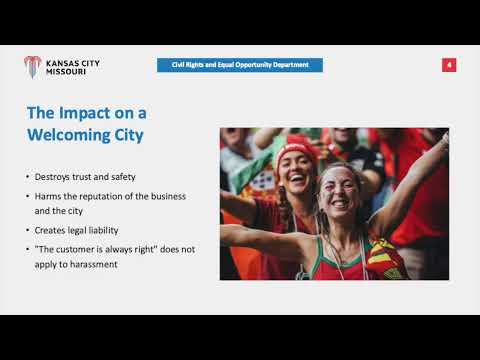
The session emphasized that maintaining professional boundaries is a first line of defense and that common customer-service maxims do not apply when harassment is involved. As the presenter put it, the old saying "The customer is always right" "does not apply to harassment." For staff encountering inappropriate comments about appearance, the presenter recommended a firm, professional response — for example, "Please keep our conversation professional." If the behavior continues, staff should step away and notify a supervisor or security.
Management duties were also stressed: managers must support staff who report incidents, and frontline workers should be encouraged to check in with targeted patrons and call for assistance if a situation feels unsafe. The presenter described frontline employees as the "eyes and ears" of a business and urged proactive, safe intervention rather than ignoring harassment.
For reporting and support, the presenter directed employees to file a discrimination complaint through the MyKCMO app or by dialing 311 and said people may also contact Civil Rights and Equal Opportunity directly. The session closed with a thank-you to participants for completing the series and a call to commit to fairness, accessibility and respect.
No formal actions or policy changes were announced during the presentation; the session served as training and information about existing reporting channels.