Get Full Government Meeting Transcripts, Videos, & Alerts Forever!
Get email alerts on the Transportation Impact Fees topic
No spam. Unsubscribe anytime.
Council signals support for staff plan to pursue up to 80% reduction in traffic-impact fees for early learning facilities
Summary
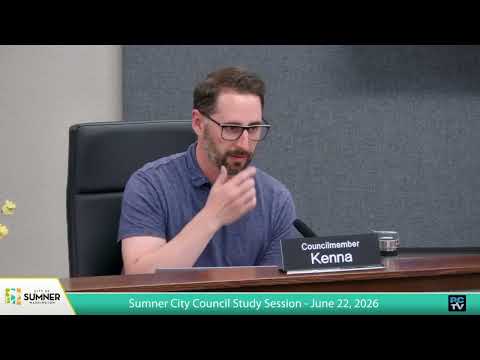
After a staff presentation on transportation-impact fee methodology and state options, Sumner City councilmembers voiced support for the staff-recommended option to pursue up to an 80% reduction in fees for early learning facilities and asked staff to place an ordinance on the next regular meeting agenda for consideration.
At the June 22 study session, staff presented options for reducing transportation-impact fees for early learning facilities (ELFs) under state law. Development Services Director Doug Beagle and staff described how the city calculates fees and why the council must balance incentivizing child care with maintaining transportation funding.
"Traffic impact fees are set by council based on traffic, the transportation plan," Beagle said, adding that the city's per‑PM‑peak‑hour trip value was $7,314.23 in the current schedule. Joe Fesler explained the technical basis: "The ITE manual... they go to actual field studies and they count cars... For early learning facilities, it's usually based on gross floor area," he said, describing trip-rate calculations, pass-by reduction factors and truck-equivalency adjustments used to compute a project fee.
Staff reviewed legal options under state law (RCW cited in the presentation) allowing councils to grant up to an 80% waiver without local backfill or a 100% waiver if the city backfills or the developer records a covenant reserving subsidized slots. After weighing trade-offs — lost fee revenue for transportation projects versus potential new ELF capacity and the administrative burden of backfill or covenant monitoring — staff recommended granting up to an 80% reduction for ELFs.
Staff illustrated impacts with examples: a 600‑square‑foot addition with today's fee of about $48,800 would be reduced to roughly $9,760 under an 80% waiver; a 2,000‑sq‑ft new facility and a 1,200‑sq‑ft tenant improvement example were also shown to demonstrate the applicant cost reduction.
Council members questioned ITE data sources and the use of the PM peak hour (5–6 p.m.) as the basis for fees, whether private independent traffic studies should be encouraged, and how a 100% waiver would be tracked or backfilled. The city attorney noted that the statute allows a partial exemption of up to 80% across the defined ELF category and that a 100% exemption carries administrative requirements if the city is to backfill lost fees.
By voice, several council members (including Hawksteader, Malcolm and Wilsey) indicated they support Option 4 — staff’s recommended up to‑80% reduction — and the mayor directed staff to prepare an ordinance for the next regular council meeting in July for formal consideration.
Ending: Staff will return with ordinance language at the next regular meeting; council direction was advisory at the study session and any fee change will require a formal ordinance and potential budget adjustments if implemented.