Get Full Government Meeting Transcripts, Videos, & Alerts Forever!
Get email alerts on the Childcare Zoning topic
No spam. Unsubscribe anytime.
Sumner City staff present ordinance to make child care centers an outright use in most zones
Summary
City staff explained Ordinance 2964 to align Sumner City code with a 2025 state law, defining child care centers and homes, allowing commercial child care as an outright use in residential and commercial zones (with industrial limits), and proposing modest performance standards; staff will return July 6 for council action.
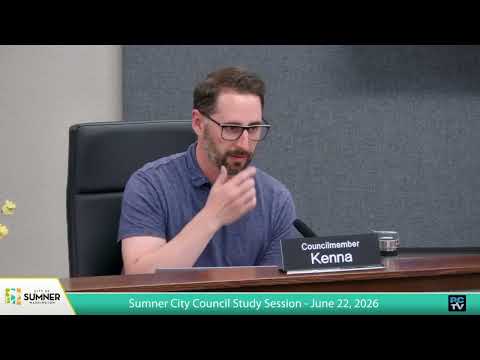
Mayor opened the June 22 study session and introduced Ordinance 2964, a zoning text amendment to clarify how Sumner City defines and permits child care centers and child care homes. Community and Economic Development Director Ryan Windish told the council the change is intended to implement a 2025 state law directing Growth Management Act cities to allow early learning facilities more broadly.
The ordinance aligns city code with state definitions. "The state law defines a child care center as an agency that regularly provides early child education and early learning services for a group of children for periods of less than 24 hours," Windish said. Under staff’s proposal, a child care center would be a commercial facility serving children from about one month through age 12; a child care home would be a licensed, home-based provider for 12 or fewer children operating in the provider’s primary residence.
The change would remove conditional-use requirements that previously applied in low-, medium- and high-density residential zones and make commercial child care an outright permitted use in those residential zones and in the city’s commercial zones. Windish told the council industrial zones remain subject to tighter limits: child care centers would either be prohibited or subject to a conditional-use review in many industrial classifications and would be prohibited if located within 1,000 feet of a high-hazard facility per building and fire code guidance.
Staff also proposed basic performance standards to reduce neighborhood impacts: limited signage in residential districts (up to two signs, a 10-square-foot wall sign or a 20-square-foot monument sign, roughly 5 feet maximum height), design review for conversions of existing buildings and compatibility expectations for family child care homes. Windish said parking and drop-off guidance would follow state law and the city’s existing code (staff noted a typical rule of one drop-off space per 20 children and a parking standard tied to employees, about 1.5 spaces per employee).
Windish cited state and research figures when explaining the policy urgency, noting the Municipal Research Services Center reported that approximately 63% of Washington residents live in a "child care desert" where demand far outpaces licensed slots and that a 2019 Department of Commerce report estimated employers face roughly $2 billion annually in turnover and missed work tied to child care shortages. "Having affordable and accessible child care is really critical to providing for the ability for people to be able to work," Windish said, highlighting Sumner City’s large manufacturing employment base.
Council members asked technical and legal questions — including whether child care homes would trigger traffic-impact fees and how strictly the code must follow state definitions (for example, the statutory distinction between home-based care of 12 or fewer children and larger commercial centers). Windish and staff confirmed that, as a change of use, licensed child care homes currently trigger traffic-impact fees and that the ordinance language was intended to mirror the state definition where required.
Next steps: staff told council they reviewed the proposal with the Planning Commission (discussion in March and a public hearing in April) and plan to return the ordinance for council action at the July 6 regular meeting.
Ending: The study-session discussion closed after council questions and staff responses; the council will consider Ordinance 2964 at the next regular meeting on July 6.