Get Full Government Meeting Transcripts, Videos, & Alerts Forever!
Get email alerts on the Land Use topic
No spam. Unsubscribe anytime.
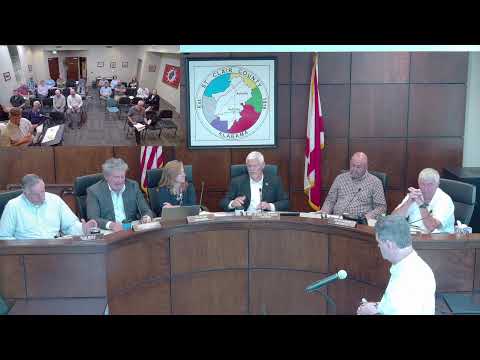
St. Clair County Commission reviews draft subdivision rules amid debate over lot sizes, septic systems and road standards
Summary
At a called work session, the St. Clair County Commission and residents spent hours reviewing a draft of subdivision regulations that would set an average lot size of 11,500 square feet (8,000 minimum in some cases), tighten road and addressing standards and require stricter oversight of septic and private sewer systems. Commissioners agreed to post the draft and hold more public meetings; no vote was taken.
The St. Clair County Commission met in a called work session to review a draft of subdivision regulations that would set an average lot size of about 11,500 square feet and a per-lot minimum as small as 8,000 square feet for some development phases.
The meeting opened with the chair noting the session was convened "specifically to address our move towards having some kind of subdivision regulations," and introducing Dan Daly, who walked the group through the draft and the sections on street names, traffic studies and lot sizes. "We came up with a lot size basically of an average of 11,500 square feet ... and one lot cannot be less than 8,000 square foot," Daly said during his presentation.
Why it matters: the proposed standards would affect how and where developers build, how many homes can be placed on rural tracts, and what infrastructure — roads, turn lanes, sewer and emergency services — local governments and developers must provide. Residents and municipal officials warned that higher density could strain local schools and emergency services; developers warned that too-strict minimums would make many projects financially impractical.
Residents and officials debated the metrics and rationale. One resident argued smaller lots multiply student demand, saying, "if you take a 8,000 square foot lot, that's going to get 1.5 kids per lot," and urged the commission to consider school capacity and associated operating costs. Municipal leaders and the Springville mayor said annexation and other municipal limits complicate how revenues such as sales tax are shared and noted that sales-tax gains from new rooftops do not always cover additional service costs.
Traffic, funding and road standards were prominent. Commissioners and staff emphasized that traffic studies and required turn lanes are triggered by traffic warrants; the meeting included an example that required turn lanes can cost "250 to $300,000" and that failure to meet state road standards can jeopardize state funding for county road projects. The draft proposes a 60-foot roadway right-of-way as a baseline but allows narrower right-of-way and variances in constrained situations; staff said some dead-end roads have been accepted at 40 feet under current practice.
Health, septic and private sewer systems drew sustained discussion. Kevin from the health department told the group that a 15,000-square-foot baseline for septic review remains in the department’s guidance but that engineers can sometimes approve smaller lots based on soil-percolation (perk) tests. Commissioners and private-sector wastewater presenters described engineered community treatment systems regulated by the Public Service Commission; those systems typically require proof of long-term funding and maintenance plans before a permit is issued.
Multiple speakers described prior problems the county has had with developers leaving substandard roads or failed onsite systems. Commissioners discussed stronger up-front requirements — including cash bonds and clearer acceptance thresholds — to protect future homeowners and avoid leaving the county or and neighbors with costly failures.
911 addressing and emergency access were raised as implementation details. Alen Campbell, the county 911 director, explained that the county is the addressing authority and that plats should include numbered lots and road names to ensure accurate dispatching and emergency response. That addressing work is a prerequisite for plat approval and utility coordination, Campbell said.
Legal and process issues surfaced repeatedly: county attorneys and outside counsel warned that an approach relying heavily on case-by-case variances can delay development, invite litigation and create financing hurdles for builders. One adviser urged building clearer entitlements into the ordinance to reduce the burden and unpredictability of variance appeals to circuit court.
What’s next: commissioners agreed to post the draft as a public "draft" and schedule additional meetings and public forums to gather more input. The chair said he will not cast a tie-breaking vote and that the measure will require three commissioners’ affirmative votes to pass.
The commission took no formal vote during the session. Officials said they expect to revise the draft following further legal review, targeted meetings with stakeholders (developers, health officials, municipal leaders and emergency services) and additional public input before returning it for a future formal action.