Get Full Government Meeting Transcripts, Videos, & Alerts Forever!
Get email alerts on the Census Training topic
No spam. Unsubscribe anytime.
Census Bureau specialists offer free, customized university trainings and demos of data.census.gov
Summary
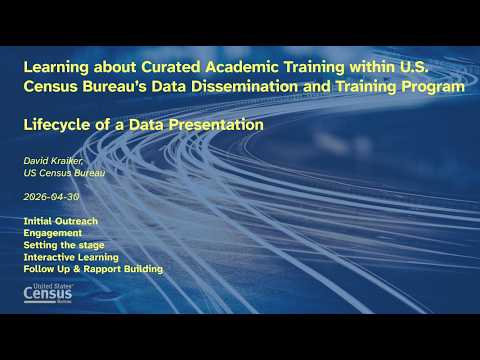
Data Dissemination Specialists from the U.S. Census Bureau demonstrated data.census.gov and related workforce tools, and described free, syllabus‑driven workshops for students, faculty and administrators during a virtual webinar.
Dr. Amy Brombos and David Kraiker, Data Dissemination Specialists with the U.S. Census Bureau, described how the bureau’s specialists deliver free, customized trainings for university classrooms, administrators and workforce offices during a virtual webinar.
Brombos said the sessions follow a four‑step framework: identify the real problem, locate federal data and tools, build a narrative from evidence, and teach transferable skills so participants can use the tools independently. "Bring us, bring the Census Bureau Data Dissemination Specialists your hardest questions," she said, urging institutions to use Census tools for both student instruction and administrative planning.
The specialists demonstrated data.census.gov functions — selecting year and geography filters, choosing American Community Survey tables, downloading and citing data, charting and mapping — and showed how those outputs can be combined with other federal tools. Kraiker demonstrated mapping features and described his goal to "democratize cartography" by teaching students how to map counts and percentages and experiment with map settings.
Brombos and Kraiker highlighted several Census tools useful to higher‑education and workforce audiences: the Post‑secondary Employment Outcomes Explorer (PSEO) for graduate earnings and placement; Census Business Builder for local industry and consumer data; OnTheMap and LEHD (Longitudinal Employer‑Household Dynamics) tools for commuting and job‑location analysis; and Quarterly Workforce Indicators for quarterly labor trends.
The presenters gave concrete examples of classroom and administrative uses: instructors can use ACS age and educational‑attainment tables to shape assignments; workforce and enrollment offices can combine ACS, LEHD and occupational projections to evaluate regional job demand and WIOA (Workforce Innovation and Opportunity Act) compliance; and PSEO can show one‑, five‑ and ten‑year post‑graduation earnings for degree programs. "One question will lead to another data set," Brombos said, noting that the power is in linking multiple data sources.
Sessions are tailored to course syllabi and audience needs, the presenters said, and can range from single guest lectures to multi‑part series or half‑day and full‑day workshops. All census data services and guest lectures shown in the webinar were described as provided at no cost to institutions.
On logistics, presenters asked faculty to send syllabi and class details in advance so exercises and timing fit course objectives; Kraiker said he typically follows up a week before a session to confirm enrollments and technical needs. They also noted in‑person visits are constrained by regional travel assignments (a roughly 49‑mile guideline was described), but virtual presentations are available more widely.
Audience members asked about practice problems, workbooks and train‑the‑trainer options. Both presenters said they commonly leave take‑home exercises and sometimes provide answers or QR codes; a workbook to accompany exercises is in development. They encouraged faculty and administrators to request customized examples and noted referrals from satisfied instructors frequently generate additional campus presentations.
The webinar concluded with the presenters inviting participants to reach out using contact details displayed on the webinar screen for scheduling and follow‑up questions. No formal actions or policy decisions were taken during the session.