Get Full Government Meeting Transcripts, Videos, & Alerts Forever!
Get email alerts on the Municipal Budget topic
No spam. Unsubscribe anytime.
Springfield officials say slowed income-tax growth leaves projected $4 million 2027 budget gap
Summary
At a June 2026 hearing, city finance staff told the Springfield City Commission that flattened income-tax growth and state-level net-profit tax changes have produced a $4 million projected general-fund gap for 2027; staff outlined timelines for the city manager's budget and called for continued deliberation.
Springfield City Commission finance staff told commissioners at a June 2026 public hearing that the city faces a roughly $4 million shortfall for 2027 under current revenue and expenditure assumptions.
“The tax budget is fundamentally a conversation about revenues and the financial environment that we expect to face in 2027,” the city finance presenter told the commission, outlining revenue trends and the schedule for the budget process.
The presenter said income-tax revenue — the primary funding source for the general fund — surged in 2021–22 (a combined increase of more than $9.2 million) but has since flattened. From 2023 through mid‑2026, growth totaled about $4.1 million, roughly 55% less than the earlier rebound years. “If that pace continued, annual income tax collections could have approached 75 million dollars by 2026,” the presenter said, citing the comparison to illustrate lost revenue opportunities.
Staff provided a line-item view of projected 2027 finances under static service assumptions and cost pressures: income tax is expected to account for about 77% of general-fund revenue (roughly $45.8 million); projected general-fund revenues were shown at about $59.4 million versus projected expenditures near $63.4 million, yielding the approximately $4 million gap. The forecast assumed no changes to service levels, a 4% increase in personnel costs, and a 5% rise in other operating expenditures.
Staff identified several drivers behind the revenue shortfall: changes in remote-work tax rules, state-level changes that affect net-profit tax liability and net operating-loss treatment, and broader economic uncertainty. Staff noted that, at the time the tax budget was prepared, income-tax collections were down about 4% (annualized roughly $2 million) and that net-profit collections were down nearly 30% through April while withholding remained positive.
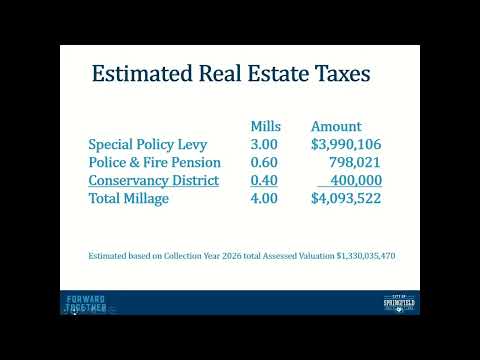
Staff also described mitigating and offsetting elements: a transition to the Regional Income Tax Agency (RITA) improved withholding compliance; new residential construction and reassessment increased assessed valuations to about $1.33 billion (an increase of roughly $304 million, or 30% over 2025); and dedicated levies — a 3-mil special police levy (~$4 million), a 0.6-mil pension-debt levy (~$800,000), and a conservancy pass-through (~$400,000) — provide constrained, earmarked revenue.
Other specifics cited included projected interest earnings near $940,000 (expected to decline about 25% in 2027), fines/licenses representing about 6% of certain receipts, and adult-use cannabis receipts of roughly $400,000 annually. Staff emphasized the city has used one-time resources in recent years (federal ARPA funds, property-sale proceeds, transfers) and noted the absence of a separate rainy-day reserve, making revenue shifts immediately consequential for operations.
A commissioner asked staff to identify unfunded mandates and the mechanics of state policy changes. Staff pointed to the historic cut to the local government fund (around 2012) and described current conversations at the state level about extending or removing a five-year lookback for net operating losses on net-profit returns, which can reduce local net-profit tax collections and increase refund activity.
During the public-comment period, a resident, Ms. Ryan, thanked the presenter (addressed in the meeting as "Katie") for the clarity of the presentation and suggested the commission consider personnel-salary adjustments as part of shared fiscal sacrifices.
Next steps: staff said the tax budget is a revenue-focused planning document and that expenditures and balancing recommendations will appear later in the year as the city manager prepares the 2027 operating budget (the city manager's preliminary budget is typically filed by Nov. 1, with public hearings and appropriations ordinances to follow).