Get Full Government Meeting Transcripts, Videos, & Alerts Forever!
Get email alerts on the Stormwater topic
No spam. Unsubscribe anytime.
Fairfax County presents 35% design update for Big Rocky Run stream restoration
Summary
County staff outlined a 35% design for the Big Rocky Run at Downstream Braddock Road restoration that would rebuild roughly 3,800 feet of channel, install natural-channel features, require two construction entrances, potentially remove 157 trees and move to 65% design this fall.
Jacob Green, a project manager in Fairfax County's Stormwater Planning Division, presented design updates on the Big Rocky Run at Downstream Braddock Road Stream Restoration Project, saying the team has completed the 35% design phase and is advancing to the next design milestones.
"My name is Jacob Green and I am a project manager in Fairfax County's Stormwater Planning Division," Green said, and explained the project's purpose: to restore degraded channel conditions, improve water quality and protect utilities that cross the stream. He described the project limits from Braddock Road downstream to Aubrey Patton Drive, on Fairfax County Park Authority property within the Rocky Run Stream Valley.
The county estimates the work will restore approximately 3,800 feet of stream channel, including tributaries, using a natural channel design approach that combines grading, realignment and in-stream structures made of rock and wood. "The goals for this project are to try and reconnect the stream to the flood plain and improve water quality by reducing erosion and therefore the sediment that enters into the stream," Green said.
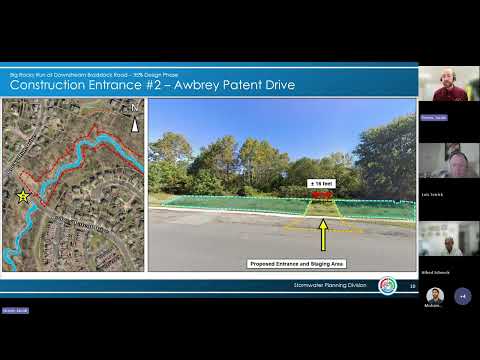
Green identified two construction access points: one on Braddock Road east of the Kiddie Academy using an existing gravel maintenance road, and a second on Aubrey Patton Drive that will cross the sidewalk and require contractor staging behind the sidewalk. Construction entrances are typically around 16 feet wide. He warned of construction-related traffic, noise and potential temporary lane closures and said the county will work with the contractor to maintain public access where practicable.
Contractors must follow Fairfax County's noise ordinance and the county's construction safety resolution. Green cited the permitted hours for outdoor construction noise: 7:00 a.m. to 9:00 p.m. Monday through Friday and 9:00 a.m. to 9:00 p.m. on weekends and federal holidays; any work outside those hours would be communicated to the community.
The presentation included vegetation and tree-survey results. Green said the county focuses on trees greater than 12 inches diameter at breast height and that "157 trees that meet this criteria have been currently been identified for potential removal"; he added that the number may change as design progresses. The county plans to reuse removed trees when feasible, replant native Virginia species such as white oak and eastern redbud within and adjacent to the project limits, treat invasive species, and provide a one-year warranty on plantings with at least three years of post-construction monitoring.
Green also reviewed benefits the county expects if the project succeeds: improved floodplain access, reduced erosion and sediment loads, better water quality, habitat for aquatic life and wildlife, improved forest health through invasive-species treatment and greater protection for utilities that cross the stream.
He cited relevant regulatory drivers discussed during the presentation, including the federal Clean Water Act (enforced by the EPA), the National Flood Insurance Program administered by FEMA, Virginia Department of Environmental Quality (DEQ) requirements under the Municipal Separate Storm Sewer System (MS4) program, and dam-safety oversight from the Virginia Department of Conservation and Recreation (DCR). Green noted Fairfax County also enforces a local erosion and stormwater management ordinance derived from state code with local enhancements.
The slide set included before-and-after photos from prior Fairfax County stream restorations (Difficult Run, Dead Run) showing vegetation reestablishment at intervals after construction. Green said the project is entering the 65% design phase, expected in the fall, followed by 95% and 100% design, permitting, bidding and construction; additional public meetings are planned after each design phase and a final meeting will be held before construction begins.
Funding sources and a construction start date were not specified during the presentation. A county colleague, Wahaj Muhammad, was introduced to monitor the chat and assist with questions during the Q&A portion.
The presentation concluded with an invitation for questions from attendees and a note that the recording will be posted to the project webpage for later viewing.