Get Full Government Meeting Transcripts, Videos, & Alerts Forever!
Get email alerts on the Traffic Calming topic
No spam. Unsubscribe anytime.
Fairfax County proposes two speed humps on Oak Drive; ballot of 46 homes requires 24 yes votes to proceed
Summary
Fairfax County Department of Transportation presented a plan to install two speed humps on Oak Drive after a traffic study showed 85th-percentile speeds of 39 mph northbound and 35 mph southbound. The plan goes to a ballot of 46 occupied properties; more than 50% (24 yes votes) are required to advance to installation, which FC DOT estimates will take about 4–8 months after approvals.
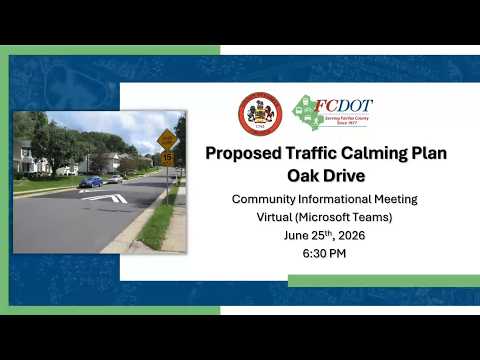
At a community meeting, Fairfax County Department of Transportation staff unveiled a traffic-calming plan for Oak Drive that proposes two speed humps and explained the neighborhood balloting and approval steps residents must follow.
Nicole Machu, a presenter with FC DOT, said the project is community-initiated and that a traffic study showed Oak Drive met the program’s eligibility criteria: about 1,200 vehicles in a 24-hour period and 85th‑percentile speeds of 39 mph northbound and 35 mph southbound—both exceeding the county threshold for consideration. FC DOT’s eligibility rules require a roadway to have 500–6,000 vehicles per day and an 85th‑percentile speed at least 10 mph over the posted 25 mph limit to advance toward traffic-calming measures.
The draft plan calls for two vertical devices (speed humps). Machu described the typical installation: a 12‑foot-long hump rising about 3 inches at the center, marked with white chevrons in each travel lane and advisory signage recommending 15 mph. Device placement must respect minimum spacing—generally 300 feet between vertical devices and from stop conditions, and 150 feet from intersections—and also must fit around driveways, utilities and road grade. FC DOT said adjacent property owners directly next to proposed devices have signed consent forms for the locations shown in the draft plan.
If the task force chooses to move the draft forward, FC DOT will distribute a ballot package to the 46 occupied properties in the ballot area. Each occupied property receives one ballot; ballots must be returned directly to the district supervisor’s office by mail, hand delivery or email/photo. "You do need 24 yes votes," Machu said, explaining the program requires more than 50% of issued ballots to be yes for the plan to proceed; unreturned ballots count as no for that threshold. Machu added that ballots collected by the task force will not be counted.
Residents asked several practical questions. In response to concerns about emergency response, FC DOT staff said emergency vehicles can experience about a 3–10 second delay per device, depending on vehicle type and device design, and that some additional vehicle noise is possible when vehicles traverse humps. FC DOT also said the county notifies fire-and-rescue agencies when roads qualify and again before installation; if fire-and-rescue formally objects to a placement, staff said the agency would raise those concerns before final approvals.
On timing, FC DOT said the County Board of Supervisors would receive the plan for endorsement and the county would then coordinate with the Virginia Department of Transportation and the Department of Public Works and Environmental Services for acceptance and installation scheduling. FC DOT estimated installation is typically scheduled three to six months after routing to DPWES and that the whole approval and scheduling sequence can lead to installation roughly four to eight months after approvals are complete.
FC DOT staff recommended outreach tactics for the task force to increase ballot participation—mail reminders, email, door‑to‑door contact and optional yard signage—and confirmed photographed ballots emailed directly to the district supervisor’s office are acceptable. The agency also recommended including postage on return envelopes to encourage returns.
The task force will reconvene after the presentation to decide whether to move to the ballot phase. If it does, the group should notify the district supervisor’s office, which will schedule a short ballot meeting and provide verified ballot packages and instructions. FC DOT said meeting materials and a recording will be posted for attendees and that staff will be available to answer follow-up questions.
The meeting ended with residents and FC DOT staff agreeing on next steps: task-force deliberation about balloting, continued coordination with fire-and-rescue as needed, and, if ballots pass, county and interagency scheduling for construction.