Get Full Government Meeting Transcripts, Videos, & Alerts Forever!
Get email alerts on the Data Centers topic
No spam. Unsubscribe anytime.
Residents urge Franklin County Commission to block hyperscale AI data centers, citing water and health risks
Summary
Dozens of residents told the Franklin County Commission they oppose rezoning for proposed hyperscale AI data centers, warning of water depletion, noise, traffic and environmental harm and urging a moratorium; speakers cited examples from other counties and called for greater transparency from developers.
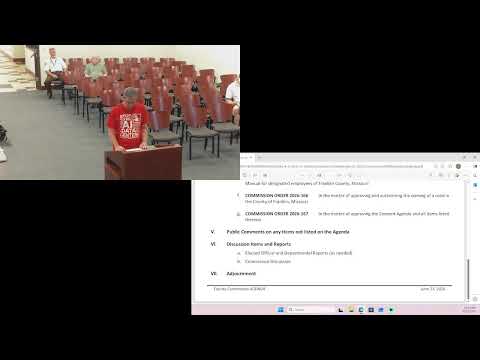
Dozens of residents urged the Franklin County Commission on June 22 to deny rezoning requests and halt hearings for proposed hyperscale AI data centers, saying the projects threaten local water supplies, livestock, wildlife and quality of life.
At the start of the public-comment period, a speaker identified by the chair as Ann said recent incidents involving Meta underline the risks of large data operations and criticized data-mining and continuous monitoring by large technology firms. "This is pretty significant in our fast little world," she said, summarizing reports of March and June 2026 incidents in which automated systems exposed sensitive information.
Nancy Watson told commissioners she had reviewed materials from Prince William County, Virginia — an area she described as "Data Center Alley" — and said nearby residents there experienced increased truck traffic, road damage, light and noise pollution and heavy water use. "When another proposed data center is built, we will be about two miles from the digital gateway," Watson said, and she urged the commission to "order a moratorium on hyperscale data centers in Franklin County and deny all four hearings."
Multiple speakers raised similar themes: Rhonda Bracket warned of aquifer pollution and long-term land damage; Travis Leighton focused on water and technical issues, saying companies have planned deep private wells and that cooling systems described as "closed loop" may be augmented with additional mechanical equipment that increases power and water demand; and others said the developments would depress property values and change rural character.
"You represent the voters of Franklin County," Janet Hubard told commissioners, asking them to seek the public's will — citing a list she said contained more than 300 people who could not attend daytime meetings — and to consider polling or an online survey. Several speakers requested town halls and more direct engagement with developers; one asked whether the county has required environmental or water studies.
Speakers named the two rezoning proposals frequently as the Provident and Beltline projects. Corbett Shannon urged the commission to "vote no," arguing the burden of proof rests with developers and criticizing the county for not providing clearer vetting and developer disclosure. Other commenters urged commissioners to prioritize residents' welfare over prospective tax revenue.
The commission enforced the three-minute public-comment limit; no commissioner response to the comments is recorded in the transcript. The meeting record shows the commission later continued with routine agenda items and an elections-office update.
What happens next: Speakers asked the commission to consider a moratorium and additional town halls, to require environmental and water studies, and to reject rezoning until outstanding questions about water supply, traffic and developer transparency are resolved.