Get Full Government Meeting Transcripts, Videos, & Alerts Forever!
Get email alerts on the School Finance topic
No spam. Unsubscribe anytime.
Dr. Herold says Independence School District faces budget risks after enrollment drop and county valuation changes
Summary
At a board work session, Dr. Herold presented the ISD budget and warned that a drop in weighted ADA, uncertainty in the state foundation formula and Jackson County assessment changes could reduce revenue in coming years; he cited a $60 million bond and strong fund balances as partial buffers.
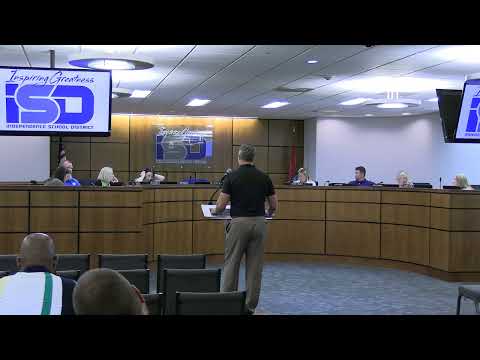
Dr. Herold opened the Independence School District board work session with the district's budget message, telling members, “Today's the second best day of the year behind Christmas. It is the approval of the budget.” He framed the presentation as both a review of the past year and a forecast of fiscal risks ahead.
The presentation noted the district’s academic performance has risen under MSIP accreditation and reported an annual performance report score of 80.5%. Dr. Herold also reminded the board that voters approved a $60 million bond that is now under construction, which he called a significant positive development for the district.
But the core of the discussion focused on revenue uncertainty. Dr. Herold told the board that the district faces pressure across its three main revenue streams: local property tax revenue (affected by Jackson County assessed-valuation actions), state funding tied to Missouri’s foundation formula, and the timing of federal funds. He said the combination of those factors creates serious fiscal uncertainty for the ISD.
A key near-term concern is enrollment. Dr. Herold reported a decline of about 500 in weighted average daily attendance (which he clarified equates to about 400 students), and explained that if that decline persists the district will see reduced foundation-formula funding beginning in FY28. "We also experience a drop of enrollment of over 500 students," he said, later clarifying "500 weighted ADA, about 400 students." Board members asked follow-up questions; Dr. Roe said he could not point to a single cause but cited homeschooling, tax-credit scholarship programs and high transiency as contributors.
The budget book shows estimated DESE ASBR operating fund balance at roughly 30.5% under current assumptions, and Dr. Herold said auditors and timing of revenue receipts (for example, Title I and the final foundation-formula payment) likely push the practical year-end balance toward about 32.5%. He cautioned that under conservative projection assumptions the fund balance could fall to about 22.16% in the third year, a level that would reduce flexibility.
Dr. Herold flagged a potential new revenue source but urged caution: an assessed-valuation projection tied to a data-center project labeled in the budget as the "Nebius Pilots." He said the first-year projection is approximately $6.3 million and that future years might yield $25–$32 million of taxable personal property value, but he characterized those numbers as uncertain and subject to fluctuation.
The presentation also detailed county actions affecting commercial property assessments. Dr. Herold said Jackson County’s executive had approved a 15% cap on commercial properties valued at $5 million or less; that change has produced withholdings and could produce multi-year clawbacks. He provided preliminary figures: recent withholdings of a little over $1 million in operating funds and about $210,000 in debt-service receipts, and an estimate of FY23–24 clawbacks of $12,819,844 (operating) and $2,976,078 (debt service).
Dr. Herold noted ESSER federal COVID-recovery funds have been fully expended and were used for capital and efficiency projects, not ongoing personnel costs, so they are not available as a continuing revenue stream. He also cautioned that proposed ballot measures to reduce or eliminate income tax would be "absolutely devastating" to the state funding base for schools and urged active legislative engagement.
Board members asked about operational responses. Dr. Herold recommended strict expenditure control, monthly monitoring of spending, cost-benefit reviews of programs and active engagement with state legislators. He also described levy mechanics under the Hancock Amendment and said the district could consider a tax recoupment process to recover funds lost to assessed-valuation changes, noting the district’s voter-approved maximum levy of $4.67 and its current operating levy near 4.3255 (as stated in the meeting).
The work session concluded with the board agreeing to collect additional questions for staff follow-up and adjourned without formal votes on budget changes.
Ending: The board will receive follow-up information and staff responses before the next regular meeting; the presentation left clear near-term tasks for monitoring enrollment, monthly expenditure tracking and engagement with state and county officials.