Get Full Government Meeting Transcripts, Videos, & Alerts Forever!
Get email alerts on the Zoning Text Amendment topic
No spam. Unsubscribe anytime.
Monroe panel approves zoning change to allow commercial kennels in industrial zone
Summary
The Monroe Planning & Zoning Commission voted Jan. 8 to amend zoning rules to permit commercial kennels and allow pet daycare/grooming uses in the I2 industrial zone via special permits; commissioners set parking and said site-specific reviews would address outdoor runs and length-of-stay details.
MONROE — The Monroe Planning & Zoning Commission on Jan. 8 approved a zoning text amendment (RAA 2025-12, file 1049) to allow commercial kennels and expand permitted pet daycare and grooming uses into the town’s I2 industrial district through special permits.
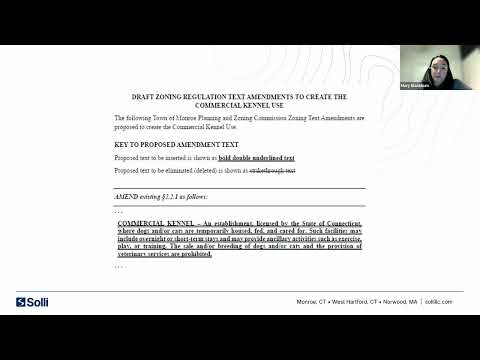
Mary Blackburn, a registered landscape architect with Soleie Engineering representing applicant Felicia Elman, told commissioners the draft amendment would define a commercial kennel in line with state licensing — "an establishment licensed by the state of Connecticut where dogs and or cats are temporarily housed, fed, and cared for" — and would permit overnight and short-term boarding while prohibiting the sale or breeding of animals and veterinary services under the use.
The amendment also proposes a parking standard of one space per 350 square feet of gross floor area (about 2.86 spaces per 1,000 sq. ft.), a rate Blackburn said matches or exceeds requirements in neighboring communities including New Town and Brookfield and is higher than the highest comparator the applicant reviewed.
Why it matters: The change would allow board-reviewed kennel uses in portions of Monroe’s industrial districts where the town said they are geographically separated from residential neighborhoods. The commission and staff emphasized that final site-specific operations — outdoor exercise areas, overnight accommodations, and any limits on the length of stay — would be controlled through special-exception review and state licensing.
During the hearing, commissioners pressed the applicant on key points. Several members asked how the amendment defines "short-term stay." Blackburn said Connecticut does not provide a single statutory definition for "short-term" in this context and recommended the commission either adopt a specific timeframe in the text or leave the detail to the special-exception process so each business could be reviewed individually. Commissioners also discussed whether outdoor exercise runs should be required to be enclosed and whether setbacks from residential zones were adequate.
A member of the public, Phil Shelton, asked whether the business already existed; Blackburn clarified this hearing concerned a zoning text amendment only and that if the amendment passed the applicant would return for a site-specific special exception, identified in the presentation as a planned follow-up at 127 Enterprise Drive (I2 zone).
Commission deliberations referenced a history of poorly run kennels in the area and asked how state oversight would intersect with local controls. A motion to approve the amendment was made and seconded; after brief discussion the commission proceeded to a roll-call vote and approved the amendment. Chair Michael O'Reilly called the motion passed.
Votes at a glance: In the same meeting the commission handled several routine procedural items. Officer nominations to continue Michael O'Reilly as chair, appoint Ryan Condan as secretary and nominate Unoini as vice chair were each approved by voice vote. The commission approved the minutes of Dec. 4, 2025, and released an $85,000 performance bond for the Prestige Place/Cutler Farm crossing development after staff reported the applicant had satisfied punch‑list items.
What’s next: With the text amendment approved, an applicant seeking to open a kennel or boarding facility in an affected industrial district would be required to apply for a special-exception or special-development permit; that review will address site design, outdoor runs, hours, and any specific limits on duration of stays. The applicant indicated it would return for the special-exception review for the 127 Enterprise Drive site if the amendment was adopted.
(Quotes used in this article are drawn from the Jan. 8, 2026 meeting record of the Monroe Planning & Zoning Commission.)