Get Full Government Meeting Transcripts, Videos, & Alerts Forever!
Get email alerts on the Subdivision topic
No spam. Unsubscribe anytime.
Commission recommends Allendale replat despite strong resident opposition over drainage, water and traffic
Summary
After extended public comment, the Natrona County Planning and Zoning Commission voted to forward MS26-01 (Allendale replat) to the BOCC with a due-pass recommendation. Residents raised repeated concerns about past grading, groundwater and stormwater drainage, proposed storage units and potential impacts to property values; staff and an engineer said a drainage study and detention design address surface runoff.
The Natrona County Planning and Zoning Commission voted to forward major subdivision MS26-01 (Allendale replat) to the Board of County Commissioners with a due-pass recommendation after lengthy public comment and discussion.
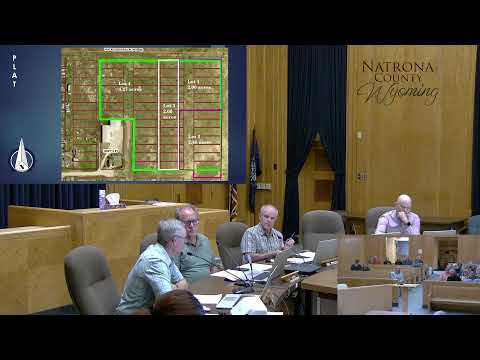
Applicants Mark and Missy Van Horn seek to vacate and replat roughly 10.65 acres in the Allendale area into four lots (two residential lots and two lots planned for commercial/storage uses). Staff presented maps, agency comments and a drainage study provided shortly before the meeting; staff found the replat met technical subdivision requirements and recommended a due-pass to the BOCC, subject to standard engineering and permit processes.
The hearing generated extensive opposition from dozens of nearby residents who testified about chronic groundwater and past flooding, recent grading they said had altered drainage patterns, concern that a detention basin would be inadequate in a major storm, safety and traffic concerns tied to proposed storage units, and fear of falling property values. Speakers repeatedly asked for more geotechnical analysis and geohydrology testing for subsurface water; residents also cited perceived title/roadway questions about historic right-of-way locations.
Applicant Mark Van Horn said he had completed the drainage study and that proposed detention/detention-pipe designs would release water at historic flows; he disputed assertions that his grading created the long-standing groundwater issues and said he would work with neighbors and may adjust pipe sizing or easements to mitigate localized issues. County/consulting engineer Bill Faringer explained the drainage study scope: it addressed surface runoff only, proposed a small detention area in the northwest corner (lot four) to slow peak flows and release at historic rates, and said properly designed detention should not materially increase groundwater. He acknowledged the study did not cover all private sump/pumping configurations or the long history of basement sump use noted by residents.
Commissioners emphasized the limited legal scope of a replat hearing (whether the plat meets subdivision rules), not subsequent site-specific design decisions (which will be handled during permit review). After deliberation they concluded the replat met applicable subdivision standards and voted to recommend approval to the BOCC; commissioners noted that site-specific building and drainage permits would be required and that many resident concerns would be addressed in those later processes.
Why it matters: The replat changes lot lines and permitted uses in a residential neighborhood and could allow future commercial storage uses near established homes; residents warned of continued flooding and increased traffic if mitigation proves insufficient. Commissioners said approving larger, consolidated lots could reduce fragmentation and that technical mitigation must be pursued at the permitting stage.
Next steps: The commission’s recommendation will go to the BOCC; engineers, the county and applicants will need to confirm drainage, sewer and access plans and any easements prior to development and construction.