Get Full Government Meeting Transcripts, Videos, & Alerts Forever!
Get email alerts on the Land Use Extraterritorial Jurisdiction topic
No spam. Unsubscribe anytime.
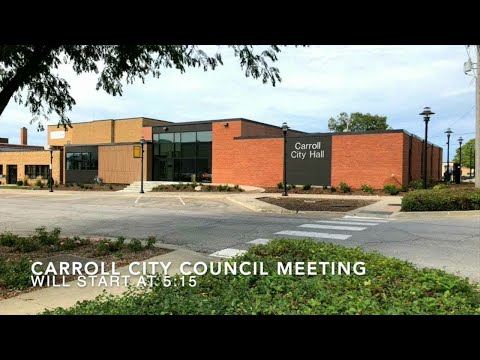
Carroll City Council weighs trimming two-mile extraterritorial boundary as county seeks compromise
Summary
Council members debated reducing Carroll City's two'mile extraterritorial boundary to one mile or another compromise, citing housing growth, permitting fee disparities, zoning overlays and legal questions; the council formed a committee to meet county supervisors and did not vote on a final change.
Carroll City Council members spent a work session reviewing demographic and planning data while debating whether to shrink the city's two'mile extraterritorial boundary after county supervisors asked that the area be reduced or abolished.
A presenter summarized U.S. Census and local comprehensive plan figures showing Carroll City's long'term growth (from 7,682 residents in 1960 to 10,321 in 2020) while the surrounding county's population has declined. The presenter said Carroll accounted for roughly 71% of the county''s new housing units between 2010 and 2020 and represented about 63% of the combined population of the county''s 13 cities. Councilors cited those figures when arguing the two'mile boundary helps preserve land for future city growth.
Supporters of keeping the two'mile buffer warned that removing or substantially reducing the area could allow larger renewable energy projects and concentrated animal feeding operations nearer to planned development, create nuisance or quality'of'life concerns, and affect property values. One council member said, "The two'mile area creates a buffer from these" and pointed to a 2015 wind farm and a 700'acre solar project elsewhere as examples of large installations that can reshape land use.
Speakers also cited recent legal and regulatory developments. One presenter referenced a 2022 Iowa Supreme Court decision and analysis from the Iowa State University Center for Ag Law and Taxation about statutory immunity for certain animal feeding operations, and noted Iowa Department of Natural Resources (DNR) separation-distance guidance that can range from just under a quarter mile to more than a half mile, depending on the facility and setting.
Chris Whitaker, introduced as local assistance director with Region 12 Council of Governments, explained a local AP overlay district created around 2010'2014 in the northeast quadrant of the city. "That overlay district created a minimum lot size of 20 acres," Whitaker said, adding that the overlay left underlying zoning in place and that in practice it did not always work as intended. He recommended the council weigh whether the overlay should remain if the extraterritorial boundary is adjusted.
A practical concern raised repeatedly was permitting and inspection fees. Councilors compared county and city charges for a hypothetical residential build: county permits described in the meeting would total roughly $200 (about $50 for a building permit plus about $150 for an electrical inspection), while city combined permits and inspections for a comparable house were described as totaling approximately $1,400 inside the two'mile area. Council members said the discrepancy affects the finances of property owners and builders and should factor into any compromise.
The council also discussed the 1990 intergovernmental (28E) agreement that references a two'mile area. A member noted that statutory language requires an extraterritorial jurisdiction "up to two miles," and questioned whether the original agreement's phrasing exceeded that statutory permission, recommending legal review before any change is enacted.
Multiple councilors urged outreach to residents who live in the two'mile area, emphasizing some purchased land with the existing boundary in mind. "People in that two'mile bought their land because it was in the two'mile," one council member said, arguing those owners deserve clear information about the consequences of any boundary change.
Rather than vote on an immediate change, councilors agreed to form a small committee to meet with county supervisors and review the questions raised; volunteers mentioned by name included Kyle, Tom and Aaron. The council asked staff to arrange the meeting and suggested including Whitaker or other regional planning staff as resources. No formal vote on changing the extraterritorial boundary was taken at the session.
The council later moved to adjourn, bringing the work session to a close.
Next steps noted by the council included assembling committee questions, contacting county supervisors to gauge their position, conducting additional research on how much the city has expanded since the two'mile rule began, and obtaining legal clarification of the 28E agreement and applicable Iowa statutes (see Authorities).