Get Full Government Meeting Transcripts, Videos, & Alerts Forever!
Get email alerts on the Emergency Services topic
No spam. Unsubscribe anytime.
Walo County public meeting outlines plan to study and possibly fund emergency medical services under Iowa Code 422D
Summary
Walo County held a public information meeting where officials explained steps under Iowa Code 422D to form an advisory council, analyze EMS performance and recommend funding options — potentially including a property-tax levy — with a board reading and advisory-council appointments scheduled for May 6.
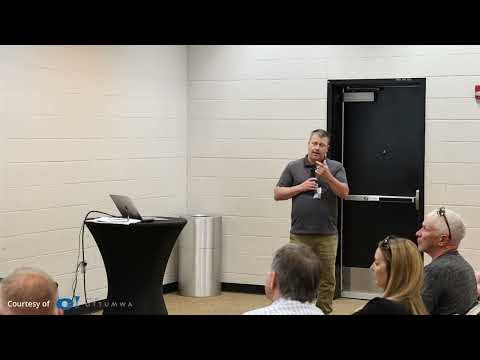
Gayla Harrison, an attorney moderating the meeting, opened a community forum on emergency medical services in Walo County and introduced county EMA director Tim Richmond and a panel of historical and operational speakers.
"EMS is not required by Iowa law," Tim Richmond, director of the Walo County Emergency Management Agency, told the gathering, framing the discussion as a local policy choice about how to guarantee ambulance response and advanced care. Richmond said the county will use the state's 2010 "system standards" rubric to measure current performance and identify gaps.
The meeting combined history with an operational assessment. Bill Reese recounted the early role funeral homes played in transporting patients in the county; Rich Gmer and other long-time participants described subsequent transitions in the 1970s and 1980s as cities, the county and local hospitals each took on portions of service delivery. Cindy Uitt and others recalled the later ORMIX-era professionalization of paramedic care and equipment.
Mark Frymore, who described recent recruitment and training efforts, said the county has pursued internships and high-school EMT pathways with Indian Hills Community College to rebuild staff; he also described pandemic-era workforce losses. Richmond presented current data he said the county is using to evaluate needs: "countywide just over 5,000 calls for emergency medical services" last year and, he said, about "78% of those calls are funded in that way" (Medicare/Medicaid-heavy payer mix), a combination the presenters said produces low reimbursement and creates a sustainability problem for providers.
Supervisor Brian Ziggler explained the county's next steps under Iowa Code 422D: the board placed a resolution on the agenda, completed two readings and scheduled a third reading on May 6 that authorizes appointment of an EMS advisory council. The advisory council, he said, will inventory calls, analyze funding options, recommend system structure (county-run, contracts with current providers such as ORMIX, hybrid models or other approaches) and estimate any levy amount for voters. "In the end, the voters get to decide this," Ziggler told attendees.
During a robust Q&A, residents asked whether ORMIX would remain an operator if the county designated EMS essential, how a levy would be described on the ballot, what the advisory-council membership would be and what incentives would keep new EMTs and paramedics working locally. Officials repeatedly said the advisory council will present options and data to the board and that any ballot measure must include language describing allowable uses and statutory caps on property-tax levy proposals.
The county staff and panel emphasized several near-term commitments: formation and public reporting by the 14-member advisory council (a smaller core group of EMS directors and subject-matter experts plus ad hoc members for specific topics), consistent public updates to the board of supervisors and posting of background documents to a public website. The board's third reading and expected appointment of the advisory council was scheduled for May 6; the council will study options over the following months and deliver recommendations to the board and the public.
What happens next: the board's May 6 reading and appointments; advisory-council data collection this summer; and a formal recommendation to the board in the fall on whether to pursue a voter-approved levy or alternative funding. No final funding decision or levy was taken at the meeting.