Get Full Government Meeting Transcripts, Videos, & Alerts Forever!
Get email alerts on the Land Use topic
No spam. Unsubscribe anytime.
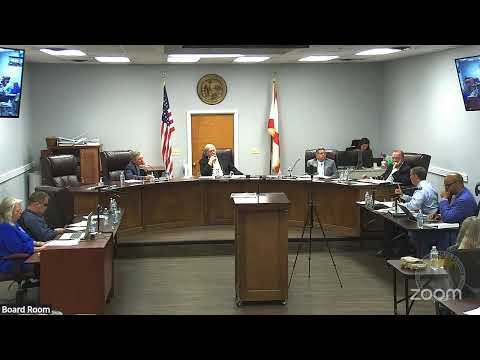
Jackson County commissioners approve ban on data centers in unincorporated areas, add staff review language
Summary
After hours of public comment for and against a proposed 35‑MW facility, the Jackson County Board of County Commissioners approved an ordinance banning data centers in unincorporated Jackson County while adding staff‑direction to develop detailed siting and review criteria and keeping a narrow exemption process.
The Jackson County Board of County Commissioners voted on June 23, 2026 to adopt an ordinance that prohibits data centers and associated facilities in the county’s unincorporated area, adopting the measure as amended to direct county staff to prepare comprehensive plan and land‑development code amendments addressing siting, infrastructure, environmental, and decommissioning standards.
The board’s amendment directs staff to draft minimum criteria — including zoning districts, conditional‑use or special‑exception processes, minimum parcel sizes, setbacks, buffers and landscaping, noise and lighting limits, water‑supply and cooling‑system rules, electric‑infrastructure coordination, backup generators and fuel storage, battery storage and fire suppression, traffic and road impact analysis, emergency response capacity, and decommissioning standards — and to return with proposed text or a written status report within 180 days of the ordinance’s effective date.
The ordinance reading by county staff framed the action as an outright ban on data centers in unincorporated Jackson County while preserving a narrow board exemption for developments the county later deems to be in its best interest. County counsel noted that future changes to the comprehensive plan and zoning would require additional public hearings under Florida law.
The measure followed more than three hours of public comment. Opponents raised concerns about groundwater and aquifer impacts, long‑term water use, grid stress, enforcement of developer promises, and the effect on rural character. As one resident said, “Please fight for our soul,” urging a permanent, strong ban. Several speakers cited discrepancies in project materials presented by proponents, specifically differences in reported water drawdown (residents pointed to both 539,000 gallons and 2,000,000 gallons cited in developer materials) and varying job and tax‑revenue estimates.
Tommy Nocera, the landowner and proposer who addressed the board, said his team would use a closed‑loop water system, described a one‑time fill figure of 539,000 gallons and an ongoing annual makeup of roughly 8,000 gallons, and said the project could generate between $3.5 million and $6.5 million in annual taxes and 40–90 permanent on‑site jobs depending on the scenario. Nocera asked the board to keep the exemption tool available so projects that can demonstrate minimal environmental and infrastructure impacts could be considered through the normal planning process. “Pass this ban, protect Jackson County from the bad actors, but don’t throw away millions in taxes and hundreds of jobs from a clean source along with it,” he said.
County staff and multiple commissioners repeatedly emphasized that the ordinance was intended to protect water resources and rural quality of life while preserving the board’s ability to consider fully documented, vetted proposals later. The final motion to approve the ordinance as amended carried; the board also approved a separate motion deleting a subsection whose language some commissioners said risked creating an easy pathway for data‑center approvals.
What happens next: the ordinance takes effect according to its terms, and county staff must return within the ordered 180 days with proposed comprehensive‑plan and land‑development code language for commissioner review and public hearings. The board and several residents said they expect additional technical review should any developer petition for an exemption or submit a zoning change.
(Reporting includes direct quotes and claims made during the public hearing and the developer’s presentation; numerical ranges above are reported by speakers at the meeting and were disputed during public comment. Vote tallies beyond “approved” are not specified in the transcript excerpts.)