Get Full Government Meeting Transcripts, Videos, & Alerts Forever!
Get email alerts on the Outdoor Lighting Regulations topic
No spam. Unsubscribe anytime.
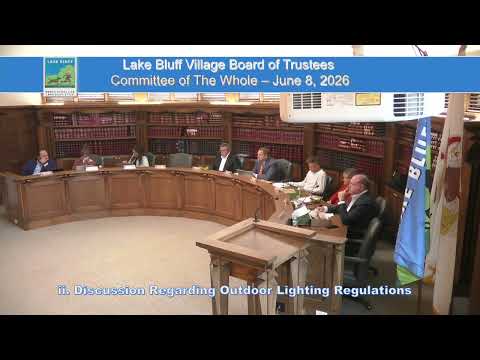
Lake Bluff trustees hear consultant on draft outdoor‑lighting rules; board to seek advisory review and community input
Summary
Trustees heard a technical presentation from consultant John Barentine on draft outdoor‑lighting regulations emphasizing shielding, 3,000 K color limits, zoning‑based light allowances and phased compliance; trustees agreed by consensus to refer the draft to advisory bodies and pursue community feedback.
A consultant advised the Lake Bluff Committee of the Whole on June 8 that the village’s draft outdoor‑lighting ordinance aligns with established dark‑sky and lighting‑engineering guidance and recommended technical changes, while trustees agreed to seek advisory review and broader community input.
John Barentine, a lighting consultant with a doctorate in astronomy who said he previously worked at the International Dark Sky Association (now Dark Sky International), told the committee the draft already incorporates the ‘‘five lighting principles’’ used in model ordinances: provide useful light, target it to where it is needed, set appropriate levels, deploy controls, and prefer warmer color temperatures. "It's about reducing waste, not turning all the lights off," Barentine said, describing full shielding, lower color temperatures and controls like timers and motion sensors as core tools.
Why it matters: trustees debated how quickly existing fixtures should come into compliance and how to balance safety and nuisance concerns. Barentine recommended a 3,000 Kelvin color‑temperature cap for general lighting, a shielding schedule tied to lighting zones, and limiting some non‑residential fixtures to about 1,000 lumens per fixture in certain zones. He also recommended amortization or phased compliance (commonly used trigger points include major renovations or fixture replacement) rather than immediate retrofits.
Trustees pressed on safety and enforceability. One trustee asked whether dimmer, warmer lighting might make streets feel less safe; Barentine replied that the evidence linking lighting color or amount to crime prevention is inconclusive and that proper uniformity and correct light levels — not simply brighter, bluer light — are important for visibility. He suggested permitting and plan review as the most effective front‑end enforcement tool, and said most municipalities handle existing‑fixture complaints on a complaint‑driven basis.
Draft specifics discussed: the draft contains technical definitions aligned with industry standards, proposes lighting zones that scale allowances by land‑use intensity, includes provisions for motion‑sensor sensitivity and short trigger durations, and contemplates an amortization schedule (consultant noted a typical upper bound is 10 years, while the draft had considered shorter periods). Barentine also urged updating sign‑code provisions for electronic displays and adopting Dark Sky guidance for sports lighting.
Next steps: trustees signaled consensus support for option 2 on the committee memo — referring the draft to the Architectural Board of Review (ABR) and the Plan Commission/Community Building Advisory (PCBA) for additional evaluation — coupled with active community outreach and formation of a resident task force to gather public feedback before the village proceeds toward formal enactment. No formal ordinance vote occurred at the meeting.
Votes at a glance: the committee approved the minutes of the April 27 Committee of the Whole meeting by voice vote earlier in the session, and later moved, seconded and approved adjournment. No votes were taken on the lighting draft itself.
What comes next: staff will include the draft in the referral to ABR and PCBA and organize community engagement as requested by trustees. Barentine offered to answer follow‑up technical questions and suggested satellite or spatial analyses could be run to quantify Lake Bluff’s relative upward light emissions if the village wants an independent baseline.
Sources and attributions: the article is based exclusively on statements and discussion from the June 8, 2026 Committee of the Whole meeting. Quotations and technical recommendations are attributed to John Barentine (consultant) and to staff member Drew or trustees when noted in the record.
Ending: The committee adjourned after the referrals and outreach plan were agreed to by consensus; formal ordinance adoption will follow whatever additional review and public input trustees request.