Get Full Government Meeting Transcripts, Videos, & Alerts Forever!
Get email alerts on the Third Street Corridor Study topic
No spam. Unsubscribe anytime.
Polk City council backs expanded Third Street corridor and town‑square study to guide redevelopment
Summary
Polk City council voted by voice to proceed with an expanded Third Street corridor and town‑square study estimated at $80,000–$85,000 to guide intersection improvements, infill redevelopment and grant applications; staff will refine scope and pursue DOT/MPO coordination.
Polk City council voted to proceed with an expanded study of the Third Street corridor and an associated town‑square master plan to better position the city for redevelopment and external funding.
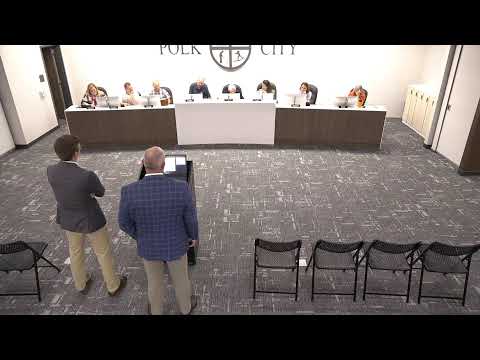
The council’s decision follows a presentation by consultant Wade Gman of Snder and Associates and staff member Wayne Travis, who said Polk City’s future land use plan was amended in June 2022 to designate Third Street as a commercial corridor but supporting planning documents were not updated. Travis said the corridor serves as the city’s primary thoroughfare and must be planned to balance new growth with existing neighborhoods such as Deer Haven and areas near Davis Street.
Gman described an expanded scope that treats Third Street as a system of nodes (major intersections) and segments (the roadway between nodes). He said deliverables would include intersection treatments (signals, turn lanes, medians), a conceptual cross‑section for the corridor, an inventory of structures older than 50 years to identify historic sensitivities, parking and square circulation studies, access‑management recommendations, and public engagement. Gman said the expanded scope fee would range from $80,000 to $85,000, depending on the level of intersection detail required; earlier, the city’s combined original estimate for the corridor and town square was approximately $50,000 and a separate CIP line had listed $24,000 (no inflation) for a narrower intersection study.
The consultant cited DOT counts updated in 2024: the corridor’s southern limits near Southside carry a little more than 10,000 vehicles per day, the West Bridge segment carries about 12,000, the segment between Bridge and Broadway ranges roughly 7,200–8,400 vehicles per day, and Broadway northwest carries about 8,500. Gman said volumes are expected to rise with development near the regional park and recommended expanding the study north to HUG Drive and south to Southside Drive to capture those growth areas.
Council members questioned what the expanded study would add beyond speed‑limit changes and what Polk City could do where Highway 415 (a DOT facility) is involved. Gman and staff responded that the study would not be a prerequisite for DOT participation but would provide the technical data, concepts and visuals that strengthen grant applications and support cooperative agreements with DOT or the MPO. They said DOT turn‑movement counts can support intersection analysis, while origin‑destination splits and longer‑range modeling come from MPO/DOT models (e.g., 2045/2050 regional models) or additional data sources such as aggregated street‑light or travel‑demand datasets.
Some council members emphasized timing and cost: several supported moving forward because the study would position Polk City for STBG‑type funding and provide marketable exhibits for grant reviewers; others worried about imposing conditions that could add cost to parcels being redeveloped and about whether the study’s timing should better align with near‑term development. Council member Jeff Savage and others said the study could be an economic development driver; council member Nick pressed staff to clarify concrete deliverables beyond planning visuals.
After discussion, the council expressed majority support to proceed with the expanded scope and directed staff to refine the reach (including whether to include Bridge/Highway 415 in coordination with DOT) and return with updated scope, cost details and outreach plans. No formal roll‑call vote on the study scope was recorded in the transcript; the decision was reached by voice agreement during the meeting.
The council then moved, seconded and carried a voice vote to adjourn.
What’s next: staff will follow up with a revised scope and seek DOT/MPO coordination and potential funding pathways; the consultant said the study would include public engagement and visual exhibits intended to improve future grant competitiveness.