Get Full Government Meeting Transcripts, Videos, & Alerts Forever!
Get email alerts on the International Baccalaureate topic
No spam. Unsubscribe anytime.
PSJA principals say IB framework builds student leadership, inclusivity and a clear PreK–12 pathway
Summary
Dr. Michelle Fox (Liberty Middle School) and Dr. Jennifer Burton (Graciela Garcia Elementary) describe the International Baccalaureate as a district teaching framework that fosters student-led projects, bilingual skills and inclusion, and say the district aims to add the DP diploma in high school.
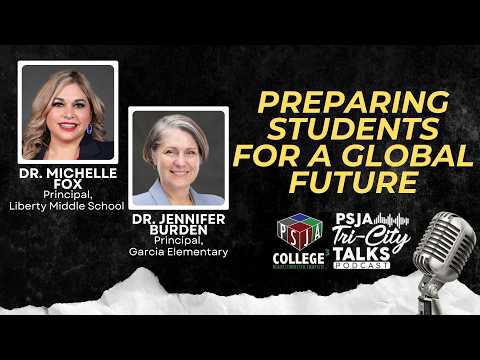
Dr. Michelle Fox, principal of Liberty Middle School, and Dr. Jennifer Burton, principal of Graciela Garcia Elementary, outlined how the International Baccalaureate (IB) framework is used across PHARR-SAN JUAN-ALAMO ISD to develop student inquiry, global-mindedness and transferable skills.
On the PSJA Tri City Talks podcast the principals said IB is not a separate curriculum but “a framework, it’s a philosophy,” that faculty embed in existing lesson plans to teach attributes such as critical thinking, communication and empathy. “We use the curriculum that we have in place within our school district and we embed the essential elements of the IB philosophy in there,” Dr. Fox said.
That approach, they said, produces student-led work across grade levels. Dr. Burton described projects ranging from first-grade living-history presentations to fifth-grade research on artificial intelligence, and noted a fifth-grade exhibition and a student seat-belt survey that led the city to invite students to present. “They come up with solutions for something that really impacts people now,” Burton said.
Why it matters: the principals linked IB classroom practice to college and career readiness. Dr. Fox said IB’s “approaches to learning” (time management, research, communication and thinking skills) are transferable to higher education and the workplace, and Dr. Burton pointed to students leaving the program with college credits and biliteracy as evidence of long-term benefits.
Both principals emphasized inclusion. Burton rejected the view that IB is only for elite or gifted students, saying her campus includes special-education and life-skills students who participate in IB activities and presentations. “They do take part in IB,” she said, adding that nonverbal students also can present and show learning in other ways. Fox said one of the campus’ most notable successes has been mainstreaming students with special needs and seeing peer advocacy in general-education classrooms.
The district has an active IB continuum at the elementary and middle years levels. Fox described the IB structure as four components—Primary Years Program (PYP), Middle Years Program (MYP), Diploma Programme (DP) and complementary elements—and said students who come from an IB elementary program arrive at middle school already familiar with the learner profile.
A stated priority is adding the Diploma Programme in high school so students can complete an unbroken PreK–12 IB pathway. “We would love to see the DP, the diploma program, held in our high schools for 11th and 12th grade,” Fox said, noting that DP would provide a capstone experience and potentially strengthen college admission opportunities.
Schools maintain IB authorization through periodic review; Fox noted recent reauthorization activity and described the five-year cycle used to confirm compliance with IB standards. The principals also described teacher training requirements—teachers receive IB-specific professional development and are expected to implement student-led, project-based instruction rather than relying on teacher talk.
Parents’ role: both principals said parents are central to IB’s success. Campuses hold ongoing parent meetings, run volunteer programs that help connect school learning to home, and encourage parents to see student exhibitions and sample presentations online. Dr. Fox pointed listeners to the PSJA YouTube channel to view exhibitions; both principals invited parents to visit classrooms and attend tours without appointments.
What was not changed or decided: the episode described practice and aspirations rather than district policy decisions. The principals framed the DP implementation as a goal; they did not announce a formal adoption timeline or a board vote.
The podcast closed with contact information and an invitation for parents to watch student exhibitions on PSJA’s YouTube channel or to schedule campus visits for a firsthand look at IB instruction.