Get Full Government Meeting Transcripts, Videos, & Alerts Forever!
Get email alerts on the Facility Reuse topic
No spam. Unsubscribe anytime.
Board weighs four options to reuse vacated classrooms at Green Hills and West Bristol as Edgewood renovation could reshape plans
Summary
The board heard four options to reuse roughly 68 seats vacated by the K8-to-K5 reconfiguration: dedicate space to special programs, a hybrid of programs and extra K5 capacity, full conversion to K5, or relocate pre-K—choices that hinge on Edgewood renovation and available grant reimbursements.
MP Planning Group presented four distinct options on Oct. 30 for reusing about 68 classroom seats that will open at Green Hills and West Bristol after the district reconfigures grade spans when the new middle school opens.
The options range from using the space for districtwide special programs with no elementary-zone changes (Option A), to a hybrid mix of programs and added K5 capacity (Option B), to full conversion to K5 instruction with substantial redistricting (Option C), to relocating pre-K into those wings if code and ground-floor access can be assured (Option D). MP Planning noted Options A and D would not require immediate elementary-zone changes, while B and C would involve shifting elementary attendance boundaries.
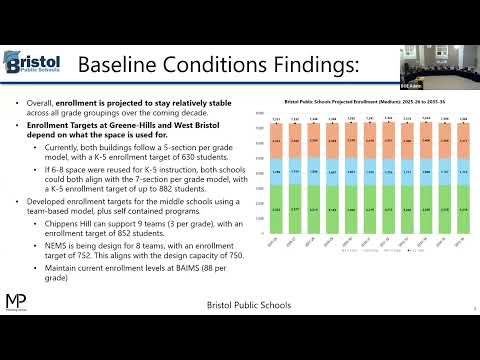
District staff and board members focused on program impacts: the district's "Destinations" multi-classroom program, breakthrough and Excel classrooms, and the need to avoid repeatedly moving vulnerable students. MP Planning said the 68-seat inventory included 20 full-size classrooms per building (about 12 grade-level rooms plus support spaces) and that restacking for K5 could increase each building's enrollment target up to about 882 students under a seven-section model.
Board members raised operational concerns: whether K5 classrooms would be appropriate sites for specialized programs, how pre-K would meet code requirements (ground-floor classrooms, egress and bathroom fixtures sized for younger children), and transportation implications. Staff cautioned that some special programs currently have limited interaction with non-disabled peers and that relocating them requires careful educational planning.
Funding and timing were central to the discussion. A board member said the board had unanimously approved changing the Edgewood project from a roof-only repair to a full renovation and that a Board of Finance vote (scheduled the following week) could confirm the district's course. Tara Landon, speaking for district staff, clarified the district has been approved for a $16.8 million state grant for Edgewood but has not yet applied for reimbursement; approximately $264,000 of local funds have been spent to date and would be eligible for partial reimbursement once the district applies.
The consultants recommended pausing any elementary attendance-zone changes until the 2027'28 school year so the district can resolve facility and program questions and avoid moving elementary students twice. The board did not make a final decision on reuse options at the Oct. 30 workshop; MP Planning will return with maps and public-engagement materials and the Board of Finance vote could narrow feasible options.