Get Full Government Meeting Transcripts, Videos, & Alerts Forever!
Get email alerts on the Redistricting Middle Schools topic
No spam. Unsubscribe anytime.
Consultants recommend aligning middle-school zones with high schools; about 580 students would be reassigned for fall 2026
Summary
Consultants hired by the Bristol School District recommended on Oct. 30 that middle-school attendance zones be aligned with existing high-school boundaries when the new NEMS opens for fall 2026, a change that would reassign roughly 580 current middle-grade students and put Northeast and Chippens near their design targets.
Consultants from MP Planning Group told the Bristol School District board on Oct. 30 that their Phase 2 redistricting work supports creating middle-school attendance zones that follow the district's high-school boundaries to keep cohorts together and match new building capacities when the new Northeast middle school (NEMS) opens for the 2026'27 school year.
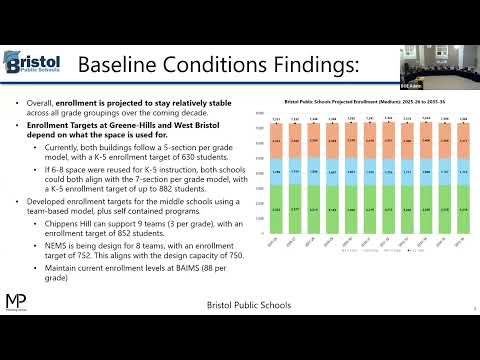
Patrick Gallagher, one of the project leads, said the consultants' 10-year enrollment projections show districtwide enrollment remaining roughly between 7,300 and 7,400 students and that the proposed middle-school pathways would produce a projected peak of about 722 students at Northeast (before adding some special-program students) and about 852 at Chippens, aligning with the new schools' design targets. Gallagher said aligning sixth grade with a single middle-school pathway would move approximately 580 students into different attendance zones for fall 2026, including students at Green Hills and West Bristol and parts of the Hubble and Stafford areas.
The consultants emphasized operational factors used to set enrollment targets: elementary class-size guidelines that translate into three-, four- or five-section-per-grade schools and middle-school team models (three teams per grade at Chippens, eight teams and a 750'752 target at NEMS). "We develop 10-year enrollment projections both districtwide and by school," Gallagher said, noting the projections helped test whether the conceptual boundaries hit those design and staffing targets.
MP Planning recommended the board adopt middle-school zones by December of the prior year to allow time for notification, routing and busing, staff assignments and any related budget changes. The consultants also recommended holding public forums and publishing an online map that would show only the middle-school changes for fall 2026 while pausing any elementary-zone adjustments.
District leaders and board members pressed the consultants on cohort-growth assumptions, transportation impacts and how many special-program students would be assigned to the new middle schools. The consultants said their models hold school-based special-program slots and current lottery settings constant when projecting impacts; they also noted that adding special-program students would reduce traditional-pathway counts rather than producing additive growth.
Next steps: MP Planning asked the board for consensus to focus outreach on middle-school boundaries at upcoming community forums and to present additional maps and tools at the Nov. 5 meeting. The board did not adopt final boundaries at the Oct. 30 workshop; a later public-engagement phase and a December adoption target were discussed as the likely timetable.