Get Full Government Meeting Transcripts, Videos, & Alerts Forever!
Get email alerts on the Assessment Results topic
No spam. Unsubscribe anytime.
Bristol Student Achievement Committee: ELA scores inch up while growth lags, district says
Summary
District staff told the Student Achievement Committee that grade 4 ELA outperformed last year and the state, but overall student growth on the Smarter Balanced Assessment has declined year-over-year; the district identified priority grades and actions including targeted coaching, curriculum adjustments and more granular strand reporting.
District staff presented Smarter Balanced Assessment (SBA) results to the Bristol School District Student Achievement Committee and reported mixed findings: modest gains in some ELA measures alongside declining overall year-over-year growth.
The presenter said grade 4 "did outperform the prior year's grade four ELA and outperform the state," and noted that while achievement in some grades rose, the district's growth metrics — the percent of students meeting growth targets and the average percent of the target achieved — trended downward.
Why it matters: achievement and growth measure different things. The presenter emphasized that higher baseline achievement makes further growth harder to achieve without different instructional approaches. The district's ELA performance index was cited in the presentation (reported in the slides as 63.2) and compared with the state figure the presenter read aloud (64.7).
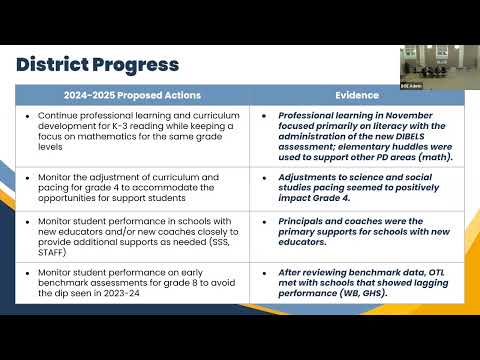
Committee members and staff discussed which grades to prioritize. The presenter identified grade 4 again as a literacy priority and added that, based on cohort patterns, the district would focus attention on grades 6, 7 and 8 for literacy and on grades 3, 4, 6 and 8 for math. The presentation listed district actions now in place: Wednesday professional-development sessions, instructional rounds, coaching communities and cross-school networking so teachers can share improvement strategies.
The presenter pointed to several implementation details: curriculum adjustments to give grade 4 more time for reading and math interventions (by rotating science/social studies), targeted coaching for beginning teachers and the use of benchmark data to trigger strategic supports for specific schools and cohorts.
Several committee members asked for more granular data. The presenter said strand-level item results from the SBA (which break performance into subskills) would take additional work to prepare but could be produced for deeper analysis; the presenter also committed to sending slide decks and updated IST/coach staffing details after the meeting.
Next steps: staff said they will provide the requested strand and IST staffing detail and expect to incorporate the state's December data release into planning. The committee flagged January budget discussions as an important opportunity to consider restoring or reallocating resources tied to student growth.