Get Full Government Meeting Transcripts, Videos, & Alerts Forever!
Get email alerts on the Right Of Way Fee Update topic
No spam. Unsubscribe anytime.
Syracuse staff propose simpler right-of-way fee tables, higher BID rates and new council review for long closures
Summary
City staff presented a proposal to replace per-square-foot staging fees with two fee schedules (public utilities; construction), adopt CPI indexing, set daily lane/road closure rates (with boosts in Business Improvement Districts), revive bonding options and require council authorization for closures exceeding 90 days. The Comstock project framed the discussion.
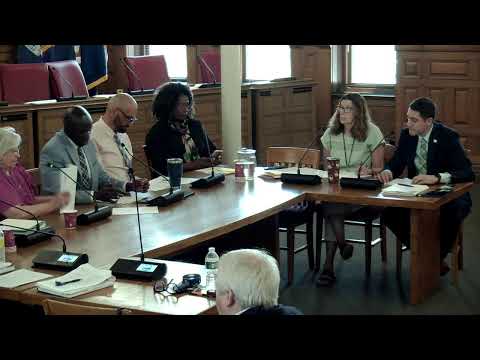
City staff presented a set of proposed changes to Syracuse Citys right-of-way ordinance that would simplify how the city charges for sidewalk, lane and road closures, add a separate schedule for public utilities, index fees to inflation and require council authorization for long-term closures.
Eric, the staff presenter, told the council the changes grew from "deficiencies" in the current fee schedule and recent experience with projects such as the Comstock Avenue closure. "We do not have the ability to go backwards or go and back date," he said when asked whether the new fees would be applied retroactively; he added the new schedule would apply going forward if the council adopts it.
Why it matters: The city is seeing a surge in construction and staff said the current per-square-foot staging rules have produced disputes and heavy administrative review. The proposed approach splits fees into two tablesone for public utility work (keeping some square-foot and staging metrics for utilities) and a new per-day structure for general construction and development that is easier to monitor and enforce.
Key provisions cited by staff include: - A short-duration category (building face to curb, sidewalk closures) charged every 14 days, with sample residential/commercial fees cited at $100 or $300 per 14-day period for small façade or repointing projects. - Daily rates for lane and road closures that escalate with duration: example figures given were $200 per day for a one-lane closure under 90 days, $325 per day in a Business Improvement District (BID); $400 per day for two lanes or a full road closure, $525 per day in a BID. Staff said the schedule steps up again after 90 days and 180 days. - A proposal to index fees to the Consumer Price Index so charges keep pace with inflation, consistent with some other city fees. - Retention of a refundable work-zone traffic-control calculation (15% of total refundable fee) and a separate utility schedule that continues to use area-based calculations for material staging in some cases. - A bonding option for refundable deposits to ease cash requirements for contractors, coupled with language to revoke bonding privileges for contractors that are noncompliant. - A requirement that any closure intended to exceed 90 days come before the council at the outset ("day 1") with complete application materials; staff also proposed quarterly reporting on compliance and a revocation process for uncured violations.
Councilors pressed staff on several points. One asked whether relying only on BID boundaries would miss other high-impact corridors such as the Inner Harbor or East Genesee Street; staff said they will refine the definition of "high density" and may expand beyond strictly BID boundaries. Another asked whether a "day" is 24 hours or a business day; staff clarified any portion of a calendar day in which the right-of-way is used counts as a day.
On enforcement and contractor burdens, councilors flagged concerns that requiring cash deposits or banker's checks strains contractors. Eric said the city switched permitting databases (from IPS to Camino) and is compiling permit and revenue data to provide better estimates; staff acknowledged they will return with consolidated counts and revenue projections. A law-related staff speaker noted the earlier ordinance amendment had been intended to address utility work and that the current proposal leaves that utility-focused schedule in place while creating a different set of rules for general construction.
Staff said the Comstock project is a primary example of where current rules produced operational questions and heavier monitoring burdens, but not the sole reason for the rewrite. They emphasized the proposal aims to standardize monitoring, reduce ambiguity, and provide lenders with clearer, longer-term approvals so privately financed projects can obtain financing. If projects exceed their authorized period, applicants must seek extensions and provide justification; revocation remains an enforcement option for uncured violations.
Next steps: Council members requested a follow-up session with consolidated permit counts, revenue figures, and enforcement data before any final vote. No vote on the ordinance took place during the session; the council adjourned to schedule further study and discussion.