Get Full Government Meeting Transcripts, Videos, & Alerts Forever!
Get email alerts on the Historic Preservation topic
No spam. Unsubscribe anytime.
New Canaan CRC subgroup weighs Certified Local Government designation to bolster preservation
Summary
A Charter Revision Commission subgroup reviewed Certified Local Government (CLG) resources and agreed to prepare a concise one-page recommendation for town officials, with plans to consult the town planner and the State Historic Preservation Office before presenting a draft to the full CRC.
Members of a New Canaan Charter Revision Commission (CRC) subgroup on conservation and preservation met to continue work started on Tuesday and to discuss whether pursuing Certified Local Government (CLG) status would help the town identify and protect historic properties.
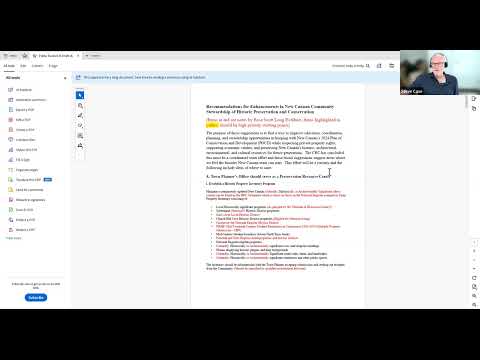
Rose Roth, who shared a document and screen view of CLG materials, walked the group through the program’s steps and benefits, advising the first step is to contact the State Historic Preservation Office (SHPO) and ask for the CLG coordinator. Members noted CLG status can provide technical assistance, surveys and eligibility for National Register nominations, and that a portion of federal preservation funding flows through the state to CLGs.
The subgroup emphasized it did not intend to recommend new rules that would unduly restrict current property owners. Several members reiterated a preference for awareness and education over regulatory imposition, and flagged that local historic-district regulations (not state or national listings) are the only instruments that impose binding review. The transcript discussion also noted the town’s ordinance already uses the National Register criteria and a 50-year ‘trigger’ to prompt demolition review.
As immediate next steps, the group asked the chair to draft a pointed, one-page summary of recommended action steps (who should do what, and to whom) and to circulate it by email for edits. They agreed it would be appropriate to have the town planner (referred to in the meeting as Sarah) serve as the municipal interface with SHPO, and to preview the draft with the planner before presenting it to the full CRC. Participants discussed timing and targeted a draft to show the CRC at or before the July 7 meeting.
Committee members also discussed process questions: distinguishing ordinance changes from charter amendments, clarifying a proposed moratorium extension (90 to 180 days) for demolition reviews as an ordinance matter, and whether the town should consider a modest budget for professional assistance rather than relying solely on volunteers. Several members reported problems with demolition-notice procedures and argued those operational gaps further support having a paid staff resource or clearer staff responsibilities in the building department or planning office.
The subgroup agreed to circulate the one-page draft and to coordinate with Preservation Connecticut and SHPO resources. No formal policy was adopted during the meeting; a motion to adjourn was made and seconded and the subgroup closed the session.