Get Full Government Meeting Transcripts, Videos, & Alerts Forever!
Get email alerts on the Municipal Budget topic
No spam. Unsubscribe anytime.
Andover moves $5.4M budget to May referendum after school- and reserve-focused public questioning
Summary
Town leaders sent the proposed FY2026–27 budget to referendum on May 5 after a presentation by the board of finance and public questions about an 11% school request, special-education staffing and whether $2.1 million in reserves should reduce the tax ask.
Andover, Conn. — Town officials moved the proposed fiscal year 2026–27 budget to referendum on April 9 after a presentation by the board of finance and extended public questioning about school spending, special-education services and the use of town reserves.
Jeff McGuire, the town’s First Selectman, opened the meeting at Andover Elementary School and urged civility as the board of finance presented the budget and supporting slides. The board described an aggregate spending plan of about $5.4 million that combines town operations, capital and the Board of Education request; the presenter said the town’s levy share is roughly 12.65% and reported the Board of Education (AES) is requesting an approximately 11% budget increase.
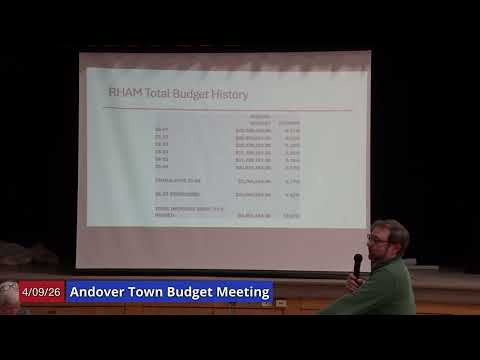
The presentation flagged several cost drivers: across-the-board salary increases (many lines at about 3%), higher health-insurance costs for town and school employees, a requested additional first-grade teacher and the end of a grant that had funded roughly half of a school psychologist’s hours. Presenters also described a one-time accounting discovery at the regional school (RAM) that will result in a refund to member towns; the presenter described Andover’s share of the refund as roughly $258,876 (transcript figure given as '258,87615').
Residents asked detailed questions during the public-comment period. On preschool and special-education staffing, school representatives said preschool tuition and two state grants together historically brought in roughly $435,000 and that preschool salaries drawn from that revenue are therefore anticipated but subject to enrollment changes. When asked whether the psychologist position was full time, the school said the psychologist had been funded in part by a grant that is ending and that the district needs more hours for testing and IEP support; the transcript records the lost grant as roughly $43,000–$54,000 in different exchanges.
Valerie, speaking for the Board of Education, described IEPs as binding legal documents that prescribe service hours for students and said the district must provide certified providers for services such as occupational therapy and physical therapy. "That is non-negotiable. That is the law," she said when explaining mandated special-education services.
Several residents pressed the boards about transparency and one-time reserves. Kathy De Roer asked why $2.1 million in unassigned fund balance was not applied to lower the tax request; presenters said the town’s unassigned funds equal roughly 15% of operating expenditures, noted state guidance typically recommends 10–15% (with some local references to Office of Policy and Management guidance), and said leaders were cautious about drawing reserves during a transition year.
After roughly an hour of questions and discussion about capital priorities (roads, bridges and culvert funds), personnel and reserves, an attendee moved to send the proposed budget to referendum; the motion was seconded by Mike Greenhouse. The assembly took a voice vote; the moderator declared the motion carried and the board authorized the budget for the May 5, 2026 referendum.
The immediate next step is the referendum. If voters approve the budget, the mill rates and billing calculations described at the meeting will be applied; if voters amend the budget at the meeting level before referendum, those changes would alter the version presented to voters. The meeting record shows no formal roll-call tally in the transcript; the moderator declared the voice vote in the affirmative.