Get Full Government Meeting Transcripts, Videos, & Alerts Forever!
Get email alerts on the Educator Diversity topic
No spam. Unsubscribe anytime.
Panel urges scholarships, coaching and apprenticeship scaling to diversify Massachusetts classroom leaders
Summary
Panelists and school leaders told the state educator diversity committee that pipeline programs work but need predictable funding, targeted scholarships and culturally matched coaching to retain administrators and classroom teachers of color. Presenters also urged licensure reform and wraparound supports for paraprofessional-to-teacher pathways.
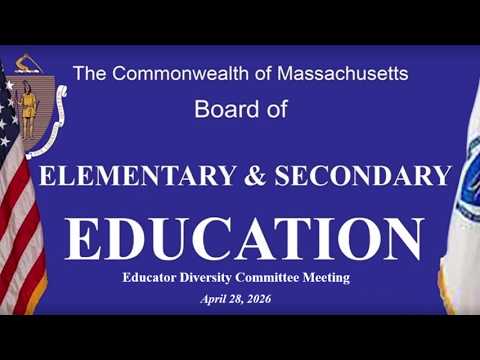
Chair Mary Anne Stewart opened the Board of Elementary and Secondary Education’s educator diversity committee listening session by saying the committee wanted to learn "what's working, what's not working, and what supports would make the greatest difference in strengthening and diversifying our educator workforce across Massachusetts." The meeting was livestreamed and recorded.
Panelists from the Massachusetts School Administrators Association (MSAA), Boston Teacher Residency, Elms College, Salem State University and UMass Lowell described a set of recurring recommendations: targeted scholarships for high-need regions, two- to three-year coaching and mentoring matched to new administrators’ backgrounds, expansion of residency and apprenticeship pathways to remove financial barriers, and reconsideration of licensure tests that panelists said exclude candidates of color.
Why it matters: Committee members said the department’s next educator-diversity strategic plan should prioritize action-oriented, fundable steps rather than additional studies. Panelists argued that short, sustainable investments—scholarships, living stipends and coach matches—can convert recruitment gains into durable hires and leaders who stay in their communities.
MSAA proposals and the "tap on the shoulder" approach An MSAA presenter outlined a multi-part strategy to grow a diverse pipeline: identify candidates in district networks (a "tap on the shoulder" approach), place them in jobs that fit their skills and contexts, and enroll new administrators in a two- to three-year administrative coaching program. "Let's not just get 32 candidates to be leaders. Let's place them where they can match and then let's get them into success," the MSAA presenter said, summarizing the group’s approach to matching, placement and retention.
Panelists asked the committee for targeted scholarships that could be deployed quickly in places such as Springfield, Worcester, Brockton and the South Coast; MSAA said it has submitted a formal proposal to the commissioner and is seeking budget support to fund several regional cadres and coaches.
Residency and apprenticeship models showed outcomes; financing remains central Jesse Solomon, executive director of Boston Plan for Excellence, described the Boston Teacher Residency model, a one-year intensive clinical residency with clustered placements, Friday coursework and multi-year induction supports. He said the program’s financing combines AmeriCorps living stipends and an education award with tuition and loan-forgiveness tied to multi-year commitments: "The quick version of finances is we tried to design and build something that would be financially viable for people who wanted to become teachers ... money should not be a barrier," Solomon said. He reported roughly 80% retention at three years for program graduates and higher rates of exemplary ratings in district evaluations relative to statewide averages.
Higher-education preparation programs described on-site courses, local practicum placements, living stipends and wraparound supports (loaner laptops, food assistance, mental-health services) to reduce obstacles such as transportation, unpaid practicums and competing work responsibilities. UMass Lowell presenters said they altered applicant processes to reduce power dynamics (opening applications to all paraprofessionals rather than relying on principal referrals) and added community-centered events to build belonging.
Licensure and testing were raised repeatedly as barriers Several presenters urged the department to examine licensure tests and alternative assessments. Dr. Tyra Good of Elms College framed the issue historically, noting that structural changes since Brown v. Board of Education contributed to the underrepresentation of Black educators and arguing that some licensure mechanisms can function as barriers: "Lensure exams ... were implemented during this era ... as mechanisms that often function to exclude educators of color from the profession," she said. Panelists recommended piloting alternate assessment pathways for paraprofessionals and other preparation routes.
Policy and sustainability recommendations Speakers pressed for predictable, ongoing funding lines rather than time-limited grants. Suggestions included a dedicated budget item to sustain growth of residency and apprenticeship programs, direct state funding to preparation programs to eliminate tuition barriers (a model cited from Tennessee), and technical assistance for districts to budget and staff pathways. Several higher-education speakers stressed the need to pair financial supports with culturally responsive mentoring and community-based approaches to ensure candidates thrive rather than just survive.
What the committee will do next Chair Stewart said the committee will synthesize the session and share insights with department leadership as it drafts the next strategic plan; she noted that although a legislative proposal (the Leads Act) was included in a governor’s package, no funding had yet been allocated. The committee scheduled its next meeting for June 2; no formal policy vote came from this session beyond approval of the meeting minutes.
Closing: The session emphasized that recruitment gains require immediate, sustained supports—scholarships, placements that match candidate strengths, culturally aligned mentors and licences paths that do not exclude qualified candidates—if Massachusetts is to grow and keep a more diverse educator workforce.