Get Full Government Meeting Transcripts, Videos, & Alerts Forever!
Get email alerts on the Prism Grant Overview topic
No spam. Unsubscribe anytime.
DESE outlines PRISM 2 and PRISM 3 literacy grants and sets 2026 application deadlines
Summary
DESE hosts a webinar detailing PRISM 2 (Pre‑K–3) and PRISM 3 (grades 4–12) grants, eligibility, competitive priorities and supports, and sets hard application deadlines: May 11, 2026 for PRISM 2 and May 12, 2026 for PRISM 3.
The Massachusetts Department of Elementary and Secondary Education (DESE) on a webinar described two competitive literacy grant opportunities — PRISM 2 for Pre‑K–3 and PRISM 3 for grades 4–12 — and laid out who can apply, which districts will be prioritized in scoring, and how to submit applications.
"I am Lori McNally, the PRISM 3 Grant Coordinator," McNally said as she opened the session and reviewed eligibility criteria, timelines and supports. Octavia Nixon, the PRISM 2 Grant Coordinator, added that both grants aim to expand evidence‑based, culturally and linguistically sustaining literacy instruction and address disparities in student outcomes.
Why it matters: DESE said both grants support districts and early‑education providers to evaluate, select, purchase and implement high‑quality instructional materials (HQIM). The awards pair funding with structured supports such as curriculum councils, professional learning, and — for certain tracks — contracted PRISM curriculum and instruction coaches intended to help districts sustain implementation.
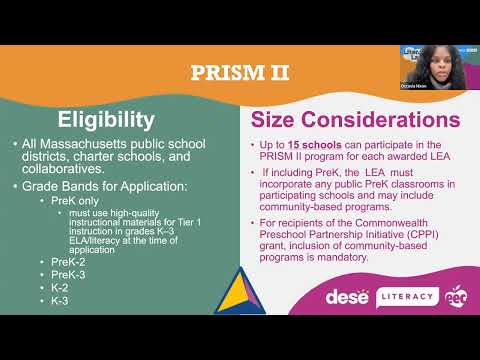
Key eligibility and priorities: PRISM 2 is open to all Massachusetts public districts, charter schools and collaboratives for specified grade bands (Pre‑K only; Pre‑K–2; Pre‑K–3; K–2; K–3). PRISM 3 applicants must meet federal CLSD eligibility, including having at least one school where 50% or more students are low‑income (40% for high schools), DESE said. Presenters emphasized that competitive priority points are additive and provide a numerical scoring advantage — examples include LEAs with below‑average Grade 3 ELA MCAS results, high shares of English learners, chronically underperforming status, or a bottom‑25% school in ELA proficiency.
Application mechanics and the deadline: DESE instructed applicants to submit proposals and budgets through GEMS, noting that applications are considered submitted only after superintendent approval in the system. "The 5 p.m. deadline is a hard deadline," McNally said, specifying May 11, 2026 for PRISM 2 and May 12, 2026 for PRISM 3; DESE said late applications will not be accepted.
What applicants should prepare: The application requires a primary contact and a designated PRISM lead, a chosen grade band and track, a list of participating schools (up to 15 per award), anticipated PD days, the district’s early literacy screener, narrative responses on readiness and equity work, and leadership and professional learning plans. DESE will publish a written FAQ with answers to questions submitted in the webinar chat and posted RFP materials and budget guides on the PRISM website.
Next steps: DESE will host office hours to help applicants and will post a recording and FAQ on the PRISM site. Octavia Nixon invited applicants to email her with PRISM 2 questions and to email Lori McNally with PRISM 3 questions; both said, because of competition rules, responses will be posted publicly rather than provided privately.
The webinar concluded with presenters reiterating required materials and timelines and encouraging early submission.