Get Full Government Meeting Transcripts, Videos, & Alerts Forever!
Get email alerts on the Body Worn Camera topic
No spam. Unsubscribe anytime.
Committee urges tougher penalties for body-worn camera failures, cites accountability concerns
Summary
Oakland committee members argued for steeper discipline when officers fail to activate body-worn cameras, proposing higher suspension ranges and termination for repeat violations while preserving mitigation for technical buffering delays.
Committee members described failure to activate or properly maintain body-worn cameras as among the most serious discipline issues currently before the panel, stressing the cameras’ role in public accountability and civil-liability prevention.
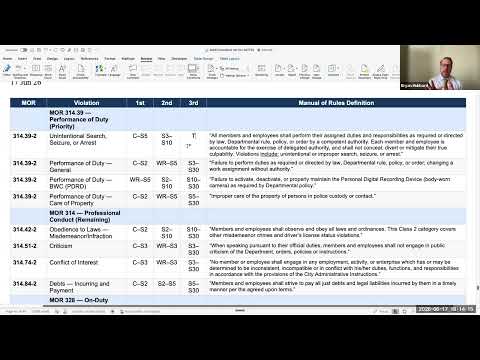
Presenting the matrix ranges, Captain Hubard explained the current structure and the way the matrix starts in the middle of ranges to allow aggravation or mitigation. Multiple members pressed for stiffer penalties than those now listed: recommended frameworks discussed included counseling up to 10 days for a first sustained failure to activate, 10–20 days for a second sustained failure, and termination on a third sustained finding. Advocates for tougher penalties cited high municipal costs from litigation in past Oakland cases and said deliberate deactivation or collusion to avoid recording should carry the heaviest consequences.
At the same time, panelists acknowledged technical and operational nuances: camera buffering may mean a device activated at the scene does not include earlier footage, and delayed activation can sometimes be mitigated. Members agreed the chief should retain discretion to mitigate in clear technical or exigent circumstances but that the top end of ranges should deter willful non-activation.
One committee member urged bluntly, "Turn those darn cameras on," arguing that the city invested in cameras precisely to have trustworthy evidence in critical incidents. The group reached consensus around raising upper ranges and aligning the body-worn camera section more closely with the search/seizure discipline structure; specific numeric language will be finalized ahead of the next meeting.