Get Full Government Meeting Transcripts, Videos, & Alerts Forever!
Get email alerts on the Search And Seizure topic
No spam. Unsubscribe anytime.
Oakland committee debates dropping 'unintentional' label, tightening penalties for improper searches
Summary
Members of Oakland’s discipline matrix ad hoc committee disagreed over whether to keep an "unintentional" category for search-and-seizure violations, with several participants urging relabeling to "illegal search" and tougher progressive penalties including termination for repeat offenders.
Members of Oakland’s discipline matrix ad hoc committee spent the bulk of the meeting debating how to classify and punish officers who conduct searches, seizures, or arrests that violate Fourth Amendment protections.
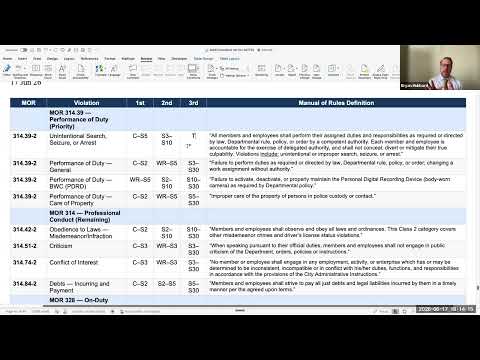
The discussion centered on MR section 314.39, listed in the packet as "unintentional search, seizure, and arrest." Some members objected that the term "unintentional" could be used to excuse conduct that is unlawful in the eyes of a court, while others said the matrix must allow room for training-based mistakes.
Captain Hubard, who presented the current matrix language and ranges, said the committee had previously removed the word "unintentional" from the manual and that the matrix would be updated to reflect that change. "We already removed the word unintentional before," Captain Hubard said, adding the updated language will eventually be imported into the discipline matrix.
Several participants argued for stronger penalties. One committee member urged that first offenses be treated as a teachable moment but recommended third offenses lead to termination; proposed ranges discussed included counseling to a 3–5 day suspension for a first sustained violation, 3–10 days for a second, and termination on a third sustained violation. Another proposed larger starting ranges—counseling up to 10 days, 10–20 days for a second offense, and termination for a third.
Speakers repeatedly emphasized harm to people subject to illegal searches: members noted that an unlawful arrest or search can lead to booking, legal fees and lifelong records for the arrestee, while the officer’s sanction may be minimal. That practical imbalance was cited as a reason to increase the upper ranges to deter repeat violations and to give the chief discretion to aggravate penalties for experienced officers.
The committee also discussed evidence and intent distinctions: some members said mistakes arising from misunderstandings of case law or from inexperience should be handled through counseling and training, while others said the matrix should not create a linguistic refuge for conduct that is, as a practical matter, illegal.
The committee did not adopt final numeric language during the meeting but agreed on three procedural points: (1) the manual-of-rules text has already had the word "unintentional" removed, (2) the matrix will be updated when the edits are imported, and (3) the panel will continue to refine the progressive ranges before forwarding recommendations for legal review and approval.