Get Full Government Meeting Transcripts, Videos, & Alerts Forever!
Get email alerts on the Land Use topic
No spam. Unsubscribe anytime.
St. Clair County commissioners debate draft subdivision regulations and proposed 11,500-square-foot average lot size
Summary
At a called work session, St. Clair County commissioners reviewed a draft of subdivision regulations proposing an average lot size of 11,500 square feet (with a per-lot floor of 8,000). Speakers debated impacts on schools, roads, private sewer systems, and addressing for emergency services; no final vote was taken and the draft will be revised and re-posted for public comment.
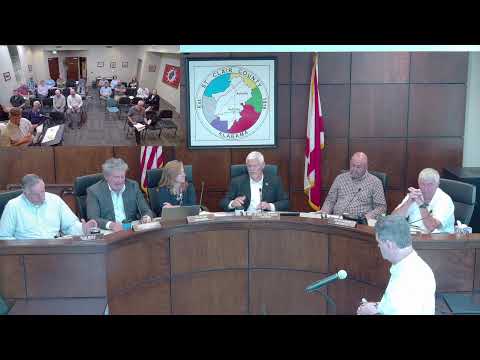
St. Clair County commissioners met in a called work session to review a draft of subdivision regulations that would set an average lot size of about 11,500 square feet per phase and a proposed minimum lot size of 8,000 square feet.
The chair opened the session and introduced Dan Daly to walk the commission and the public through the draft. Daly said the draft is a work-in-progress and highlighted several open questions, singling out lot-size averages, road and right-of-way standards, and requirements for private sewer systems and bonds. “We came up with an average of 11,500 square feet ... and any one lot cannot be less than 8,000 square foot,” Daly said during the presentation.
Why it matters: Commissioners and members of the public framed the lot-size choice around what local governments must provide—schools, police, fire protection and roads—and who pays. Several residents and municipal officials argued dense development can create short-term service strains, while developers said restrictive minimums can kill projects that pay for infrastructure such as turn lanes and sewer extensions.
Public services and schools were a central line of debate. Multiple speakers warned that new subdivisions can produce rapid enrollment increases that local schools must absorb; commissioners and mayors noted that some state funding formulas follow students but that local timing and capacity constraints still cause short-term fiscal stress. One commissioner summarized the tension: growth brings new rooftops and potential retail, but it can also create a funding shortfall in the first years after development.
Traffic and roads: County staff and the commission said traffic warrants often trigger developer-paid turn lanes and other road improvements—projects that can cost “$250,000 to $300,000” or more in some cases. Officials emphasized the county will require traffic studies where warranted and that compliance with state roadway standards affects eligibility for state road funding.
Sewer systems and environmental risk: The draft addresses private engineered sewer systems as an option where centralized sewer is not available. Commissioners pressed on who would be responsible if a private system later failed and discussed moving from surety bonds to cash bonds to protect taxpayers and future homeowners. One health-department representative said a 15,000-square-foot minimum has historically been used as a guideline but that engineered approvals can allow smaller lots when a soil scientist and engineer certify the system.
911 addressing and tiny-home/mobile-home clusters: Alen Campbell, the county’s 911 director, told the commission that addressing must be assigned before plats are signed so emergency responders can locate residents; the county is the addressing authority and will continue requiring lot numbers and road names prior to final plat approval. Attendees also raised questions about RV parks, tiny-home neighborhoods and mobile-home parks that can host permanent residents but fall outside typical subdivision review.
Legal and procedural issues: County counsel warned that across-the-board requirements (for example, mandatory right-of-way dedication in every case) could raise constitutional takings concerns; the counsel also explained that variances and appeals can lead to long litigation delays. Commissioners said they plan to work with outside land-use counsel and the Alabama Association of County Commissions to refine language and ensure a defensible, tailored approach.
What happens next: Commissioners agreed to post the current draft as a public document, solicit broader public input and hold additional meetings (including larger-format sessions) to refine the regulations. No formal vote was taken at the work session. The chair said he would not cast a deciding vote until at least three commissioners were ready to approve a final text.
The commission encouraged residents to review the posted draft and said the county attorney and Dan Daly would continue to tweak the language, particularly on the definitions of “subdivision,” lot-size metrics, variance criteria and bonding requirements.