Get Full Government Meeting Transcripts, Videos, & Alerts Forever!
Get email alerts on the Environment topic
No spam. Unsubscribe anytime.
Bloomington council unanimously adopts Urban Forest Master Plan, calls for staffing and right‑of‑way planting program
Summary
The Bloomington City Council voted 6‑0 to approve an Urban Forest Master Plan that maps canopy priorities, calls for a right‑of‑way planting program, recommends increased staffing relative to peer cities, and projects a sharp drop in emerald ash borer costs as removals wind down.
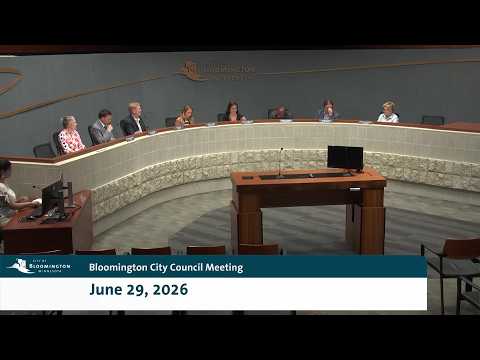
The Bloomington City Council on June 29 unanimously approved the city’s Urban Forest Master Plan, a data‑driven roadmap city staff say will guide long‑term tree canopy management, right‑of‑way planting, and resilience planning.
Deputy Director of Parks Renee Clark and Dave Hanson, assistant director of parks and natural resources, presented the final draft and highlighted the plan’s six strategic goals, short‑ and long‑term recommendations, and measurement tools. Hanson said Bloomington’s tree canopy grew about 5% over a 10‑year study period despite emerald ash borer (EAB) impacts and reported the city now inventories 717 ash trees remaining on public property compared with roughly 8,500 at the start of the city’s EAB response.
“We now have all this really concrete inventory data that says we have 717 ash trees left on public property,” Hanson said, noting that EAB‑related removal costs should decline sharply in coming years.
The plan recommends a proactive right‑of‑way planting program, a public‑facing dashboard using tree‑keeper software to track canopy condition and work orders, and increased staffing and budget to align Bloomington with peer cities. Hanson told council the city’s effective forestry FTEs equal about six full‑time equivalents — roughly 1.4 FTEs below comparable communities — and staff recommended evaluating staffing and budget needs to support a more proactive approach.
Council members asked how the plan aligns with the city’s Climate Action Plan and how staff will incentivize private‑property planting; staff said near‑term priorities are already identified and longer‑term work will be synced with climate planning and community outreach. Council member Robertson moved to adopt the plan and direct staff to implement recommendations and any additional direction given on the record; the motion was seconded and passed 6‑0.
Why it matters: The plan sets priorities for urban canopy investments and creates an actionable framework for planting, preservation, and performance measurement intended to improve environmental benefits, equity in canopy distribution, and resilience to pests and climate impacts.