Get Full Government Meeting Transcripts, Videos, & Alerts Forever!
Get email alerts on the School Budget topic
No spam. Unsubscribe anytime.
Granby officials flag $847,772 FY27 budget gap, outline cuts and ask town for help
Summary
Superintendent Mary Jane Rickson told a packed public hearing that Granby Public Schools faces a working FY27 shortfall of $847,772 driven by special-education placements, rising health insurance and reduced grant offsets; officials outlined first-round cuts, warned of trade-offs, and scheduled a forum and an April vote.
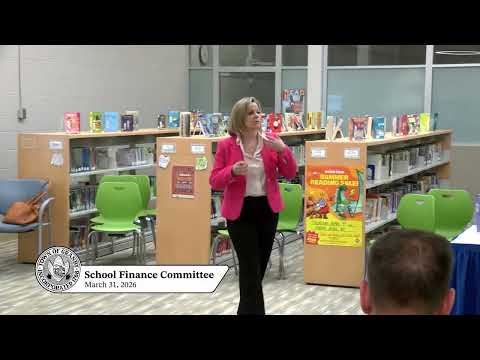
Granby Superintendent Mary Jane Rickson told residents at a March 31 public hearing that the Granby Public Schools faces a working FY27 budget shortfall of $847,772 and presented options to narrow the gap, including service reductions, program cuts and continued negotiations with town leaders.
"This budget is not a final budget," Rickson said, stressing the district’s numbers are preliminary while the town searches for a new town administrator and final town allocations remain uncertain. She said the administration built the FY27 proposal from data and multiple planning rounds and will revise figures as town and state numbers solidify.
The administration reported Chapter 70 state aid at about $4.9 million and said it used a conservative $400,000 placeholder for the town’s contribution this year. With operating expenditures near $12 million, staff said the district’s funding gap began at roughly $1.4 million before known offsets; after initial adjustments and first-round reductions the working deficit stands at $847,772.
Finance staff (introduced by the superintendent as the district’s director of finance and operations, Mr. Dorman) highlighted three main drivers: high and unpredictable out-of-district special-education placements and transportation costs, a sharp rise in health insurance premiums, and reduced grant offsets. On reimbursements, Mr. Dorman explained that circuit breaker claims are retrospective: "They reimburse at 75" for eligible costs above the threshold, meaning the district must front costs and receive reimbursement later.
Officials outlined cuts already considered to reduce the gap to roughly $594,000, including reductions in some athletics and curriculum spending, scaled-back technology repair and replacement, reduced contracted special-education services, and delays to nonessential capital such as gym floor refinishing and playground mulch.
Rickson and finance staff stressed the trade-offs of different budget approaches: a "level-service" budget aims to maintain current services while a "level-funded" budget freezes dollar allocations and can mask future reductions when inflation and costs rise. They warned that relying on one-time or temporary savings (for example an unexpected tuition decrease) could jeopardize future maintenance-of-effort requirements tied to federal grants.
Residents asked questions about state aid prospects, rural-aid volatility and regionalization. Using the governor’s budget as a baseline, officials said modest per-pupil increases at the Legislature would help but are unlikely to close the district’s gap alone. One resident noted rural-aid volatility—rural aid was about $27,000 when first provided to some communities, rose to more than $100,000 in one year, and is currently estimated near $50,000 for Granby—making it an important but unreliable offset.
Several speakers discussed regionalization as a long-term option. Officials cautioned that regionalization is complex, often takes five to seven years to implement, and does not guarantee near-term savings; it can also reduce local control over curriculum, staffing and assessments.
On operations, the administration said transportation costs are currently a placeholder pending a joint bid with a neighboring town and noted contracts include fuel-surcharge benchmarks that shift costs when diesel prices change. Capital items discussed included a municipal generator replacement (out to bid as a capital article) and the suggestion from a resident to seek targeted warrant-article votes to replenish technology rather than relying solely on the operating budget.
Multiple commenters urged preserving technology and instructional services; administrators answered that Chromebook fleets are aging, repairs are unpredictable and past large-scale replacements depended on one-time grant or federal and state funding. "These are the painful choices," a staff member said, describing trade-offs between staffing and device replacement.
The committee closed the hearing after public questions and said it will host a forum next week with updated numbers and plans to revisit the budget and take a final vote at its last April meeting in time to prepare for town meeting.