Get Full Government Meeting Transcripts, Videos, & Alerts Forever!
Get email alerts on the Child Protection topic
No spam. Unsubscribe anytime.
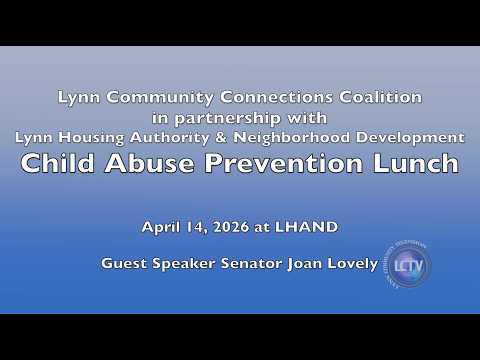
Lynn coalition convenes DCF, housing officials and state lawmakers at child-abuse prevention luncheon
Summary
The Lynn Community Connection Coalition hosted its annual child-abuse prevention luncheon where Lynn DCF shared caseload data (about 580 families served and roughly 2,800 reports in FY2024), and legislators and housing partners discussed prevention, kinship placements and community resources.
Brandy Rodriguez, director of the Lynn Community Connection Coalition, opened the organization’s annual child-abuse prevention luncheon by welcoming partners from local agencies, the housing authority and the state delegation and by distributing an updated community resource book.
Tracy Gilmore, area clinical manager at the Lynn DCF office, reviewed recent local caseloads: “the Lynn area office serviced about 580 families. That's a pretty substantial number. And we took in about 2,800 reports of abuse or neglect,” she said, and added that the most frequent concerns involve substance misuse, domestic violence and significant mental-health issues. Gilmore said caseloads have declined in recent months but that mental-health needs for both parents and children have increased.
Gilmore highlighted the agency’s use of kinship care: more than half of youth entering placement in the Lynn area are now placed with kin, she said, an increase of about 10 percentage points from the prior year. She framed that shift as a priority because kin placements keep children with relatives or people they know and, where possible, stabilize family units while services are provided.
Senator Joan Lovely, who was introduced by Sen. Brendan Crighton, praised the local partnerships that support prevention work and urged continued coordination between schools, police, shelters and treatment programs. “Awareness is the first step towards knowledge. Knowledge is the first step towards change,” she said, praising the coalition’s materials and work with DCF.
Harry McCabe, chairman of the board that hosts the luncheon, closed the program by thanking volunteers and staff and describing the coalition’s long-running efforts to connect families to services and supplement direct assistance such as holiday food distributions and youth programs.
The gathering was presented as an opportunity to strengthen referrals and local collaboration rather than to take formal votes or adopt policy at the event. Organizers encouraged attendees to use the resource book and to continue interagency conversations about prevention and early supports for families.