Get Full Government Meeting Transcripts, Videos, & Alerts Forever!
Get email alerts on the Telecommunications Infrastructure topic
No spam. Unsubscribe anytime.
Point Pleasant Beach planning board reviews Verizon plan for 170‑foot monopole; experts say coverage and emissions meet standards, residents raise visual and le
Summary
At a June courtesy review, Verizon’s experts told the Point Pleasant Beach Planning Board that a proposed 170‑foot monopole at 416 New Jersey Ave would replace antennas on the municipal water tank, restore and improve wireless coverage and meet FCC exposure limits; residents raised concerns about visual impact, maintenance and lease terms.
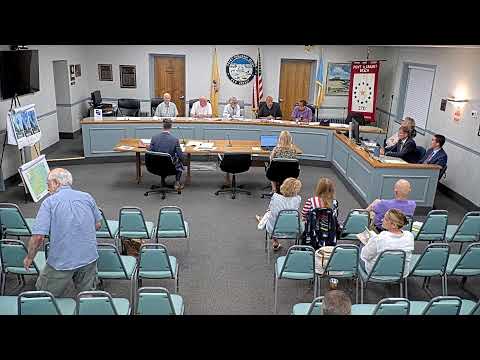
Point Pleasant Beach — At a June 16 courtesy review, the Point Pleasant Beach Planning Board heard testimony from Verizon’s counsel and two engineers about a proposal to relocate telecommunications antennas from the municipal water tank at 416 New Jersey Avenue to a new 170‑foot monopole sited adjacent to the tank.
Michael Beck, counsel for Selco Partnership doing business as Verizon Wireless, told the board the municipal bid required moving antennas off the water tank and removing an existing 100‑foot lattice tower. Andrew Peterson, a radio‑frequency engineer for DVM Engineering, testified that propagation models in his June 5 report show the water‑tank site currently provides strong in‑building coverage across most of the borough but leaves spotty coverage in the northeast; decommissioning the water‑tank site without a replacement would cause measurable coverage and capacity losses. Peterson said the proposed monopole (carrier centerlines at roughly 167, 157 and 147 feet) would “replace what’s there today” and improve in‑building coverage in the northeast.
Peterson also presented an electromagnetic‑exposure analysis using FCC methods and upper‑limit assumptions. He testified the calculated exposure for the proposed monopole and all three carriers would be about 0.17% of the applicable FCC limit — “roughly 600 times below the FCC standard” — and that the existing water‑tank configuration calculates at about 0.26% of the limit (about 400 times below). Peterson said such calculations are worst‑case and that field tests often yield still lower values.
Jacob Minardi of Network Connects, a licensed civil engineer, described the monopole’s structural design and site work. Minardi said the monopole would be 170 feet from grade with a 5‑foot lightning rod; foundation design follows the 2021 International Building Code, TIA‑222 standards and ASCE 7‑16; because the site is coastal the design uses exposure category D and a wind design speed of about 121 mph. He said ground cabinets would remain in place and be remotely monitored, that cabling would be undergrounded, and that no lighting is proposed unless the FAA determines it is required. Minardi also presented photo simulations submitted with the application and explained the borough considered a “monopine” stealth option but chose a standard monopole as more appropriate for the developed, coastal setting.
During Q&A, board members asked whether post‑installation field testing is performed; Peterson said municipalities sometimes require testing and his experience shows measured levels are often an order of magnitude below calculated worst‑case results. The applicant said carrier equipment will likely be swapped over with minimal service interruption and that structural re‑analysis will be performed whenever future equipment changes are proposed.
During public comment, multiple residents urged the board and applicant to consider visual impacts, proximity to homes, long‑term maintenance and removal requirements. Speakers asked whether the lease requires the applicant to remove the monopole when carriers no longer use it; a board representative noted the lease includes an initial five‑year term with renewable extensions and removal‑at‑end‑of‑term language, and said the borough expects the property restored if the carriers leave. Residents also asked how antenna mounting brackets will be removed from the water tank and whether corrosion or future maintenance would be adequately addressed.
The planning board closed public comment and took no formal recommendation on the contract (the board’s role at the courtesy review is limited to offering recommendations on master‑plan conformity; the governing body retains authority over the lease). A motion to adjourn carried by voice vote. The governing body’s contract and related permits (including any required FAA determination) remain the next procedural steps.