Get Full Government Meeting Transcripts, Videos, & Alerts Forever!
Get email alerts on the Legislative Roundup topic
No spam. Unsubscribe anytime.
Tennessee Revenue webinar: brownfield credits, EV fees, trailer exemptions and other 2023 tax changes
Summary
Revenue attorneys summarized several enacted 2023 measures affecting state tax administration: brownfield remediation credits, expanded industrial machinery exemptions for a mega‑site, a 3‑day trailor removal exemption extension, repossession credit rules, higher EV registration fees and aviation fuel tax caps, among others.
Phil Fitzgerald reviewed a series of enacted changes beyond the Tennessee Works package during the Department of Revenue webinar.
He said Public Chapter 53 expanded the industrial machinery exemption to cover materials purchased by contractors performing wastewater treatment work at the state 'mega site' associated with Blue Oval City and Ford Motor Company development, and that the Mega Site Authority of West Tennessee (attached to General Services) is included among public entities for the exemption.
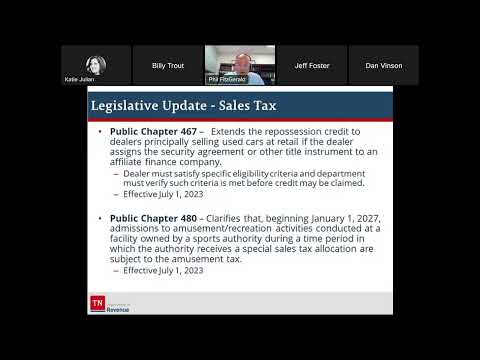
Public Chapter 449 extends a 3‑day sales tax removal exemption to personal (noncommercial) trailers removed from Tennessee within three days of purchase; Revenue updated a 3‑day affidavit on its website for buyers to document eligibility. Public Chapter 467 broadened eligibility for a repossession credit for dealers principally selling used cars when an affiliated finance company takes assignment of security instruments and met specific criteria; Revenue must verify eligibility before the credit is allowed.
Fitzgerald described Public Chapter 86, which creates a remediation‑cost‑based brownfield tax credit for tier‑three and tier‑four counties with a $500,000 maximum credit that may offset franchise/excise tax and (per the Tennessee Works package) may be carryforward‑eligible. He also summarized Public Chapter 159, which raises electric and hybrid vehicle registration fees (temporary and then permanent amounts were described), with those fees allocated in the same way as gas tax receipts to highway funds, municipalities, counties and the general fund.
On aviation fuel, Public Chapter 455 sets caps on taxable remittances for licensed air carriers with Tennessee transportation hubs, stepping down the cap amounts across the 2023–2024 period and then applying a lower cap thereafter. Public Chapter 28 cleaned up safe‑deposit box notice requirements to align with the 2015 repeal of the inheritance tax, and Public Chapter 370 removed the litigation tax for adoption proceedings in chancery, circuit and juvenile courts.
Fitzgerald closed by directing attendees to the department’s updated tax manuals and the webinar resources page for implementation details.
Why it matters: these changes alter eligibility for exemptions and credits, change modest fee structures tied to transportation funding, and adjust administrative notice and tax‑remittance caps that affect carriers and dealers. Businesses and local administrators will need the department’s guidance to follow the new rules.
Next steps: Revenue said tax manuals have been updated on tn.gov/revenue and that additional webinars and guidance are planned to address administrative questions.