Get Full Government Meeting Transcripts, Videos, & Alerts Forever!
Get email alerts on the Reporting Requirements topic
No spam. Unsubscribe anytime.
MAPC training outlines how municipal energy managers must document quarterly grant progress
Summary
At a virtual training hosted by MAPC, Mass Save partners and utility representatives walked municipal energy managers through quarterly reporting requirements, the 90‑day work plan, portal upload steps and key grant deadlines (quarterly report due Oct. 31).
At a virtual training hosted by the Metropolitan Area Planning Council, presenters from Mass Save, National Grid, Eversource and the NEAT project walked municipal energy managers through the Municipal Energy Managers grant quarterly reporting requirements and the portal submission process.
The session began with the program’s lesson question — “how do I complete the quarterly grant reporting requirements to remain in good standing and demonstrate progress?” — and a brief poll that found many participants neutral or unsure about their confidence in completing reports. Organizers said the training’s objectives were to clarify report criteria and the information managers should collect, not to provide a lengthy how‑to on portal navigation.
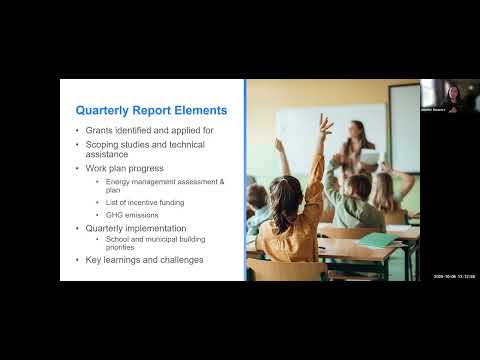
Lori from National Grid, who led much of the instruction, emphasized that the quarterly report is both a compliance document and a management tool for municipalities. “My take on this reporting is, yes, we need to have an understanding of the progress that you’re making,” she said, urging managers to build simple tracking tools that can expand over time. Presenters recommended a 90‑day work plan that documents recent accomplishments, a three‑month pipeline of prioritized projects for schools and municipal buildings, and short notes on key learnings and challenges.
Report sections to prepare include a grants table (grants applied for and dollar amounts), status and uploads for portfolio prioritization plans and comprehensive building assessments (scoping studies offered at no cost), and a 90‑day work plan that can include appendices such as building inventories and CSVs of municipal/school priorities. Presenters displayed example tracking spreadsheets that capture building ownership, year built, square footage, EUI (energy use intensity), equipment age, past conservation measures, likely electrical service upgrades for electrification and ties to potential incentive dollars.
Shannon of the NEAT project demonstrated the portal workflow: resource-for-recipients → reports → quarterly report. She showed how awardees select their grant application, list up to 10 grants, upload PDFs for scoping or assessment documents, and submit the 90‑day work plan. Shannon noted a practical detail: the portal does not show a persistent visual cue after upload, so users should prepare materials before starting and confirm attachments in their grant application page after submission.
Presenters called out several grant windows and eligibility details attendees should track when compiling reports: Green Communities (annual report due Nov. 7; summit Nov. 18), a second round of the MassCEC Green School Works grant, and the Transforming Energy and Schools initiative (TESSIE), expected late fall. Organizers said TESSIE will be competitive and generally requires a completed comprehensive building assessment and service to schools with about 40% low-income students to be eligible; Green School Works was noted as having an additional $20 million forthcoming.
A compliance boundary that prompted attendee questions: organizers clarified that time funded solely by the Energy Manager grant may not be spent on municipal aggregation projects because the grant is ratepayer-funded; if a manager is working on aggregation they must use other funding or a portion of their hours outside the MEM grant to cover that work.
On technical assistance, presenters recommended two tiers: a portfolio prioritization plan (PPP) to identify the largest emitters in a portfolio and suggest which buildings to study, and a comprehensive building assessment — a deeper, 10–30 page study for selected buildings. The PPP provides a high-level, one‑page per building view to help prioritize; the comprehensive assessment is the more detailed diagnostic.
Organizers closed by committing to post templates and example documents on the portal, run additional trainings (annual reporting, Mass Save incentive programs, grant writing) and hold a Program Learning Network meeting on Oct. 15. Presenters encouraged managers to collect basic building metrics (square footage, equipment age, site contacts, EUI) as those figures frequently appear in grant applications and are useful for demonstrating progress.
Next steps: quarterly reports will be due on the stated deadline (confirmed in Q&A as Oct. 31), templates and example spreadsheets will be uploaded to the portal, and additional trainings on annual reporting and program incentives are scheduled in the coming weeks.