Get Full Government Meeting Transcripts, Videos, & Alerts Forever!
Get email alerts on the Playbook Launch topic
No spam. Unsubscribe anytime.
Metropolitan Area Planning Council launches Climate Resilience Playbook to help towns move from planning to projects
Summary
MAPC and partners unveiled an online Climate Resilience Playbook with 120+ actions and about 20 implementation blueprints to help Massachusetts municipalities translate climate plans into fundable projects; EEA leaders said the tool will be integrated with state programs and funding pathways.
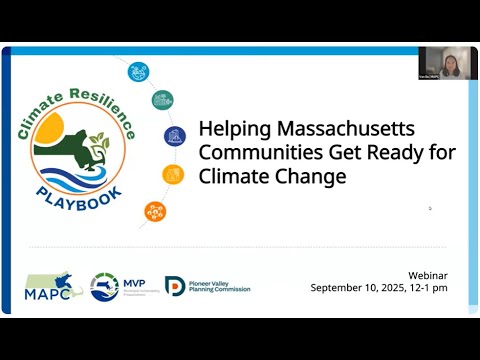
The Metropolitan Area Planning Council on Tuesday launched a Climate Resilience Playbook — an interactive online tool that catalogs more than 120 municipal actions and roughly 20 implementation blueprints intended to help cities and towns move from planning to implementation.
Van Du, MAPC’s Director of Environmental Planning, said the playbook is “a living, evolving resource” designed for communities at different stages of resilience planning, and that users can filter actions by climate threat, project type and implementation effort. “We made this playbook to be an online tool…that provide[s] guidance to municipalities in pursuing actions that advance climate resilience,” Van said during the hour-long webinar.
The playbook combines planning resources (primers, case studies and downloadable templates) with an action database that surfaces step‑by‑step blueprints for projects such as culvert assessments, residential cooling programs and worker-safety outreach. MAPC staff demonstrated two user scenarios: a conservation commission screening actions for inland and stormwater flooding, and an environmental planner identifying blueprints to address urban heat islands.
State officials said the tool is meant to remove barriers to implementation. Katherine Antos, Undersecretary for Decarbonization and Resilience at the Executive Office of Energy and Environmental Affairs, said the playbook complements the state’s Municipal Vulnerability Preparedness (MVP) program and the Resilient Mass Finance Strategy. “The finance strategy lays out a roadmap for how Massachusetts will fund and finance and scale the pace of implementation of resilience measures,” Antos said, noting that EEA awarded $52 million in MVP Action Grants last year and that the Mass Ready Act proposes $315 million for MVP over five years.
Maya Mansfield, Assistant Secretary for Resilience at EEA, said the playbook aligns with the Resilient Mass plan and the Resilient Mass Metrics Framework so communities can select actions that map back to state goals. Kara Runsten, director of the MVP program, said each blueprint lists potential funding and technical-assistance avenues and encouraged communities to use the newly launched Environment and Climate One Stop to match projects to appropriate state programs.
Developers emphasized equity and local collaboration. Van and others said the playbook includes guidance for centering equity across project phases and features content on partnering with Indigenous communities. Kenneth Comia of the Pioneer Valley Planning Commission noted small towns’ practical constraints — washed-out dirt roads, limited staff — and said the playbook lifts up replicable local practices for those contexts.
MAPC and Pioneer Valley Planning Commission said they will continue to add blueprints and encouraged users to submit feedback through the site’s feedback and technical-issue links. The webinar recording and slide deck will be posted on the Resilience Playbook website.
Next steps: MAPC asked users to test the site and send suggested actions or case studies; EEA officials said they will integrate the playbook into MVP resources and the state’s new one‑stop grant portal to help communities move from idea to funding.