Get Full Government Meeting Transcripts, Videos, & Alerts Forever!
Get email alerts on the Youth Sports Commercialization topic
No spam. Unsubscribe anytime.
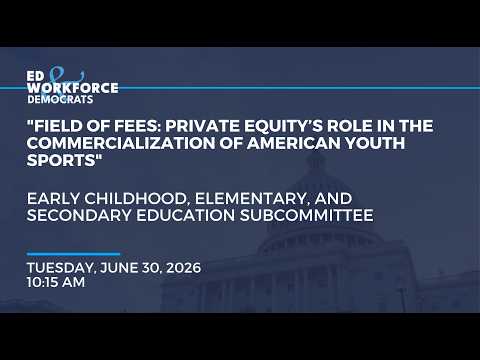
House subcommittee hearing spotlights private equity’s role in pricing families out of youth sports
Summary
At a House Education and Workforce subcommittee hearing, witnesses and members said consolidation and private‑equity investment in youth sports have increased costs, narrowed choices for families, and widened participation gaps; witnesses urged stronger antitrust enforcement, fee transparency, and targeted public funding to restore local access.
At a House Education and Workforce subcommittee session, lawmakers and four witnesses testified that consolidation and private‑equity investment have transformed youth sports into an expensive, vertically integrated industry that sidelines community programs and prices out low‑income families.
Catherine Van Dyke, senior fellow at the American Economic Liberties Project, told the panel that private investors have built a ‘‘flywheel’’ in which serial acquisitions and vertical integration lock families into costly ecosystems of leagues, facilities, tournaments and affiliated travel and lodging. "When fewer companies control more of an industry, competition declines, prices rise, and families are left with fewer affordable choices," Van Dyke said.
Linda Flanagan, author of Take Back the Game, described a shift from volunteer‑led, low‑cost local recreation to a performance model focused on early specialization. Flanagan cited higher rates of overuse injuries and urged registries, safety standards for coaches, and limits on predatory business practices. "It’s not that they lack talent or determination—it's that their families simply cannot afford the rising costs," she said.
Matt Kekabeek, executive director of the Kalamazoo Optimist Hockey Association, gave a concrete example of the risks he says consolidation creates. He told lawmakers that his 60‑year nonprofit was effectively forced out of its longtime rink after the facility’s acquisition by Black Bear Sports Group and described the buyer’s demands as "coercive and heavy handed," resulting in an eviction that left his organization without a home.
Brian Finnerty, founder of High Velocity Sports, argued private capital can expand access when mission‑aligned and accountable to local communities. "The question is whether it remains accountable to the mission of youth sports," Finnerty said, adding that responsible operators reinvest in programming and scholarships.
Lawmakers on both sides of the aisle pressed witnesses on potential remedies. Witnesses and members discussed a mix of approaches: stronger antitrust scrutiny focused on cumulative acquisitions, reporting rules to flag serial rollups, bans on extractive practices such as forced travel‑booking 'state of play' requirements and junk fees, increased public funding for school and park programs, enhanced fee transparency to parents, and state‑level coach training programs to reduce injuries.
Members repeatedly referenced the Let Kids Play Act (also discussed in testimony) as a legislative vehicle to limit certain private equity practices in youth sports. Van Dyke recommended requiring reporting of cumulative acquisitions and making investors liable for debts and safety violations tied to the operations they control.
Committee members also focused on practical local concerns: the cost of travel and lodging for tournaments, lost volunteer engagement when nonprofits lose access to facilities, and how commercialization and NIL incentives can push families toward early specialization. Members noted the hearing record will remain open for 14 days for supplemental statements; no votes were taken.
The subcommittee did not advance legislation at the hearing. Members asked staff to consider options that combine enforcement, transparency, and targeted public investment so that participation is determined by ZIP code or talent—not family income.
The record remains open for 14 days for written submissions to the committee clerk.