Get Full Government Meeting Transcripts, Videos, & Alerts Forever!
Get email alerts on the Transportation Infrastructure topic
No spam. Unsubscribe anytime.
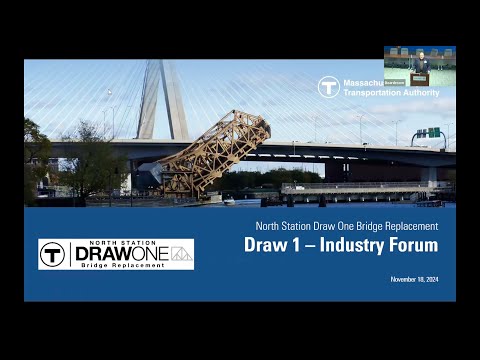
MBTA details scope, schedule and procurement questions for North Station Draw 1 bridge replacement
Summary
MBTA and its design team presented a 75%-design plan to replace Draw 1 at North Station with three vertical-lift spans, expand tracks and Platform F, and coordinate NEPA and permitting; they said the program is included in the MBTA CIP at $1.2 billion and has an active USDOT/FTA grant of $472 million while permitting, procurement packaging and construction staging remain on the critical path.
The Massachusetts Bay Transportation Authority on Monday laid out plans to replace Draw One — the movable bridge that carries four commuter-rail tracks across the Charles River from North Station — saying the structure is the system’s highest-priority infrastructure project for the north side.
"The North Station Draw 1 Bridge is a cornerstone of the MBTA infrastructure," said Sam Zhao, chief engineer and assistant general manager for capital programs, in opening remarks. He and project staff told industry representatives the replacement is necessary to maintain and expand commuter-rail service on the Fitchburg, Haverhill, Lowell and Newburyport/Rockport lines.
Why it matters: Project presenters said the north side accounts for roughly 160 of the MBTA’s ~500 weekday commuter-rail trains and about 30,000 weekday passengers. Failure of the existing movable spans would severely constrain service across multiple lines and to Amtrak’s Downeaster (seven daily trips), the team said.
What the plan is: The design — at approximately 75% complete — would replace the existing Scherzer rolling lifts with three Louisiana‑style vertical-lift spans to fit the tight footprint. The design raises mechanical and electrical equipment above flood elevation, adds redundancy in the lift drives, expands track capacity on the approaches, and creates or extends a sixth platform (Platform F) to add boarding locations without increasing the station footprint.
Project team and permitting: Mark Ennis, the project manager from STV, said the program has been carved into three permitting components for NEPA purposes: North Station work, the bridge work (which requires a full Environmental Assessment), and the track/signal improvements. The team reported active Section 106 consultations for historic resources and said a memorandum of understanding with consulting parties is near completion.
Funding and budget context: Presenters said the MBTA included $1.2 billion for the program in last year’s capital improvement plan and that the project has an active USDOT/FTA discretionary grant of about $472 million; project staff said federal participation could ultimately reach up to roughly 80% and that the grant funds are in the process of being obligated. Project-level construction cost estimates cited in Q&A were roughly in the range used for NEPA and planning: the presenters said the construction estimate underlying their current studies was just under $875 million and offered a high-level breakdown used for planning (track/signal work north of the site roughly $120–125 million; Platform F roughly $40 million; the bulk of the remainder in bridge and structure work). The MBTA emphasized that packaging, procurement strategy and final cost allocation remain subject to change.
Schedule and staging constraints: The team said early-action packages could be procured first but stressed the core constraint is maintaining operations: at least four active tracks across the river and a minimum of eight of North Station’s 10 tracks must remain available during construction. Presenters described a multi-stage build (stage one about 2.5 years for early actions and procurement, stage two another ~2.5 years, and stage three ~2 years), producing a conceptual seven-year construction duration in the current plan. The draft Environmental Assessment is under FTA review, the team said, with an EA target completion cited for March 2025. Presenters estimated enabling work could begin mid–late 2025 and heavy construction could begin in 2026, contingent on NEPA, obligating funds and procurement packaging decisions.
Technical and neighborhood constraints: The design team highlighted substructure issues (more than 1,400 timber piles dating to 1930, many not reusable), a constrained marine site that requires barges and temporary trestles, a pedestrian bridge conflict that requires pier relocation and a ~12‑inch vertical raise, and the need to remove legacy caissons and debris from prior demolished spans. They also noted coordination with the US Coast Guard and the Department of Conservation and Recreation for navigation and park impacts.
Procurement and industry input: MBTA staff said they have not yet decided whether to bundle the program into one large contract or multiple packages and solicited feedback at the industry forum and via a project email/website (D1IndustryForum@MBTA.com). Presenters noted Massachusetts currently does not permit progressive design‑build procurement under state law; MBTA and MassDOT staff said they are pursuing a legislative proposal to enable progressive design‑build in the future but cautioned any change would be subject to the legislative process.
Questions from industry: In a question-and-answer session, a Parsons representative asked for a per-stage cost split; MBTA staff said the construction estimate used in planning was just under $875 million and reiterated the rough breakdown (track/signal work ~$120–125 million; Platform F ~$40 million; remainder to bridges and structures) while noting those figures are conceptual planning numbers and subject to refinement in procurement documents.
Next steps: The project team said presentation materials and the recorded video will be posted on the project website, that they will hold one-on-one industry meetings over the next two days, and that they expect to accept written feedback through the forum email/website over a short window. The NEPA Environmental Assessment review and Section 106 coordination remain critical path items; project staff indicated final procurement packaging decisions are expected in the coming months and that PM/CM procurement is targeted for 2025.
The MBTA framed the forum as pre‑procurement: an opportunity for industry to offer input, not part of the formal procurement itself.