Get Full Government Meeting Transcripts, Videos, & Alerts Forever!
Get email alerts on the Ell Services topic
No spam. Unsubscribe anytime.
Director: Marlborough’s EL action plan approved; 16 students to re-enter EL after review
Summary
The district’s Director of English Language Learner Services told the committee the state-approved action plan addresses equity, staffing and translator training; she said 16 students will be re-entered into EL after data review and family outreach and explained ACCESS exit criteria.
Miss Lin Medal, the district’s director of English language learner services, told the Marlborough City School Committee that the district’s Tiered Focus Monitoring action plan has been approved by the state and the district is now in the progress‑reporting cycle, with reports due in March, June and September.
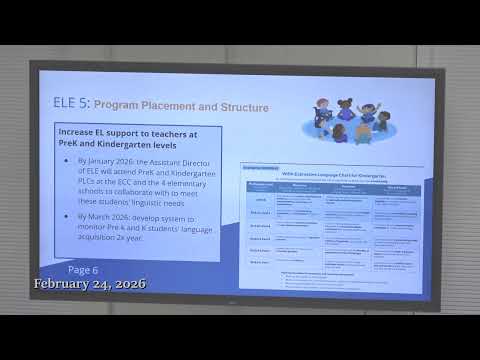
Medal said the state’s findings focused on three areas labeled EL5, EL6 and EL7. On EL5 — equity and inclusion — she said the district adjusted scheduling so early‑stage EL students at Wickham (grades 6–8) can participate in grade‑level history and civics classes while still receiving English language development instruction. Medal said the district is working with a redesign cohort and preparing a companion document for teachers to align academic language to social studies standards.
On reclassification (EL6), Medal explained the ACCESS exit criteria that now govern exits: “in order to exit you need to get an overall score of a 4.2 and a literacy score … of a 3.9.” She said a district review found some students had been exited without meeting the ACCESS criteria in prior years; after reviewing grades, MAP/NWEA data and teacher monitoring forms and discussing options with families, the district will re‑enter 16 students into EL services (about 8% of the reviewed cohort) to make sure supports match student needs. Medal said the district will not re‑exit any student who does not meet the formal ACCESS criteria moving forward and that exited students are monitored twice a year for up to four years.
Medal also described EL staffing steps and walkthroughs to support sheltered English instruction, and said the district is exploring grade‑specific EL teacher assignments and greater coordinator participation in PLCs to deepen classroom support. On EL7, she outlined a three‑tier translator training plan the state expects: tier one (an online module for bilingual staff), tier two (training for translators who will work in parent and IEP meetings with virtual sessions scheduled April–June), and planned tier three training for technical IEP conversations in the following year.
Committee members pressed on timing and monitoring: ACCESS is used once a year for reclassification (January), but Medal said teachers use midyear data for recommendations and the district will continue twice‑annual monitoring and family outreach. She described outreach to families, including translated forums explaining scores, the reason for exits, and what re‑entry would mean. Medal said the district will present updates to the committee in June.
The committee did not take formal action on EL items at the meeting; administrators said implementation details and scheduling will continue to be developed and reported to the committee.
The next procedural step is the district’s March progress report to the state; Medal said she will return with results and more detailed metrics in June.