Get Full Government Meeting Transcripts, Videos, & Alerts Forever!
Get email alerts on the E Mobility Regulation topic
No spam. Unsubscribe anytime.
Clive advances first reading of new e‑mobility ordinance after debate over 'emoto' definition
Summary
The Clive City Council advanced Ordinance 1178 on first reading June 11 after lengthy discussion about how to define higher‑power electric devices. Stakeholders and staff debated whether the term 'emoto' or 'electric motorcycle' should appear in the code; council voted 5–0 to move the ordinance forward.
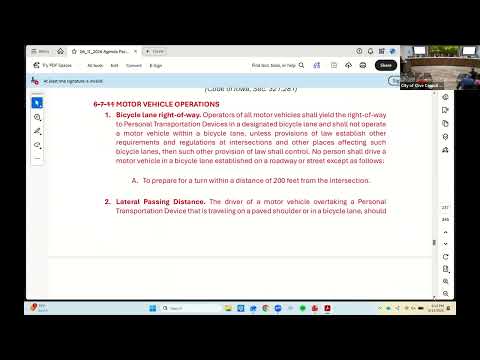
The Clive City Council voted 5–0 on June 11 to advance Ordinance 1178 for its first reading, adopting a red‑lined update to the city’s traffic and pedestrian code that reorganizes device definitions and adds new safety language for bicycles and electric mobility devices.
The police chief, Amanda Rayberg, told the council the changes are largely editorial — moving definitions into alphabetical order and clarifying language — but that the ordinance also adds new device categories, revises references to state traffic code chapter 321, and retains a 20‑mph speed standard for trails. Rayberg said devices with higher power and speeds will be treated as motor vehicles and will therefore carry licensing, registration and insurance requirements under state law.
Alex Rice, executive director of the Street Collective, told the council she supports clearer, simpler messaging to residents and parents and urged removing or refining the word "emoto" from the ordinance so it does not create public confusion. "When parents shop for a device, they need straightforward guidance — say 'ebike' or 'electric motorcycle' — so they know where a device is allowed to ride and what licensing it requires," Rice said.
Rayberg responded that the city’s classification is driven by measurable thresholds (staff described 750 watts as a key breakpoint and higher speed capabilities as determining motorcycle versus e‑bike treatment) and that the emoto term was intended as a practical, inclusive label for devices that look unlike traditional motorcycles but exceed low‑speed thresholds. He emphasized education over heavy enforcement in early implementation.
The ordinance also: re‑incorporates bicycles into the personal transportation device definition after a clerical omission in a draft; adds an ADA‑focused provision for pedestrian paths and trails; includes a hand‑signal recommendation; and retains age and licensing distinctions that mirror state code for mopeds and motorcycle endorsements.
Council members said they favored consistency across the metro area but also appreciated the need for local clarity. Staff said they will continue outreach with stakeholders, including the Street Collective, and return with revised language for subsequent readings. The council’s vote advanced the ordinance for further consideration; second and third readings and final adoption were scheduled for future meetings.