Get Full Government Meeting Transcripts, Videos, & Alerts Forever!
Get email alerts on the Pre Practitioner License topic
No spam. Unsubscribe anytime.
Department of Education to allow provisional pre-practitioner licenses; mentoring and attestation rules clarified
Summary
The Department of Education announced a new pre-practitioner license to allow provisionally admitted post-baccalaureate candidates to begin coursework while preparing for required Praxis exams; the policy requires mentor verification, an attestation form signed after mentoring, and will take effect Oct. 20.
The Department of Education announced a revision to certification policy that will let approved Louisiana teacher preparation providers provisionally admit post-baccalaureate candidates and obtain a pre-practitioner license while the candidates receive targeted exam-preparation supports. Rachel Norman, the department's director of certification, said the policy was approved at the June board meeting and "will be going into effect on October 20th of this year."
Under the revision, preparation providers may provisionally admit candidates who have not yet passed the required Praxis content exam; the Department will be able to issue a pre-practitioner license while candidates complete up to 12 credit hours of targeted coursework and supports. "Candidates will be receiving targeted support to both prepare for and pass the required content exams," Norman said. The department emphasized that candidates cannot begin their residency or serve as teacher of record until they have passed the required content exam.
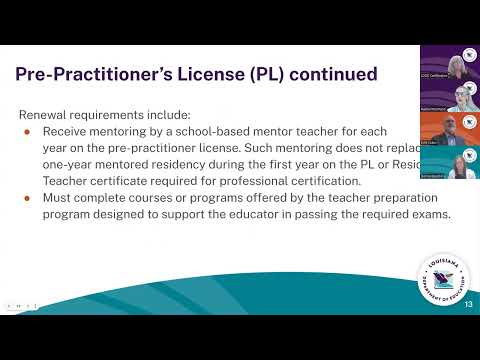
Norman outlined renewal and documentation conditions: the pre-practitioner license may be held for up to two years (issued one year at a time). Renewals require verification that the candidate remains provisionally enrolled, participation in exam-preparation supports, completion of approved coursework (no more than 12 credit hours or equivalent contact hours), and evidence of a minimum of two attempts at the required content exam. Each year the license is held, the candidate must receive mentoring from a school-based mentor; that mentoring is in addition to, and does not replace, the one-year mentored residency required for initial certification.
Speakers clarified that mentor qualifications and timing are material to certification decisions. Lee, a mentor-program presenter during the extended learning session, said mentor teachers must hold one of the following before mentoring begins: a mentor teacher endorsement, a provisional mentor teacher ancillary certificate, a valid mentor teacher ancillary certificate, or an approved mentor teacher waiver for the school year in which mentoring occurs. Carmen, who led the attestation overview, said the mentoring attestation "serves as a legally binding agreement between the teacher candidate, the mentor teacher, and the LEA" and must be signed by all three parties; signature dates on the form must be after the mentoring end date.
The Department warned that credentials or waivers added after the verified mentoring period will not be accepted to validate prior mentoring and that submitting false documentation could result in certification sanctions pursuant to bulletin 746. The department will require verification of any approved mentor waiver for the period when mentoring took place and, if mentoring occurred with multiple mentors, an attestation form for each mentor documenting the specific mentoring dates and associated credential or waiver.
Brett Collins of educator development said mentor waivers will follow a new cycle intended to better align with certification timelines: the 2026–27 traditional mentor waiver cycle opens June 15 and will close October 1, 2026; the spring 2027 cycle opens Nov. 1 and closes March 1, 2027. Systems with questions about mentor stipends or funding were directed to mentorandcontentleaders@la.gov.
Next steps: the Department plans a FAQ document on the pre-practitioner changes and will post slides and a recording to the School System Support Library; staff encouraged school systems with individual cases to schedule office hours for case-specific reviews.