Get Full Government Meeting Transcripts, Videos, & Alerts Forever!
Get email alerts on the Mass Energy Insight topic
No spam. Unsubscribe anytime.
DOER deputy director Mark Drabinsky outlines Mass Energy Insight updates and annual‑report guidance for Green Communities
Summary
At a state training, Mark Drabinsky of the Green Communities Program demonstrated Mass Energy Insight (MEI), urged careful data review (delivered fuels record delivery, not use), explained vehicle fuel‑efficiency flags and VIN imports, and reminded communities that annual reports are due Nov. 7.
Mark Drabinsky, deputy director of the Green Communities Program at the Department of Energy Resources, led a webinar demonstration of Mass Energy Insight (MEI), the state’s municipal energy‑tracking tool, and urged attendees to check data carefully ahead of annual reporting.
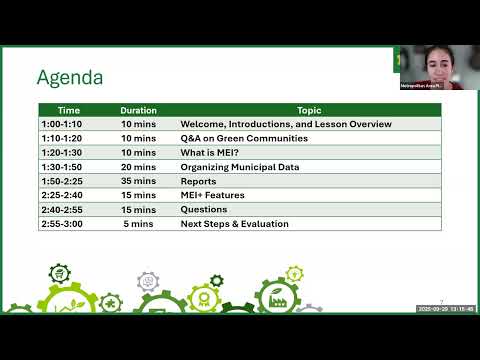
Drabinsky opened the session by walking participants through MEI’s home screen, the faster beta site and recent "MEI plus" features intended to reduce manual reporting burdens. He said the system now allows users to toggle between multiple towns, export data, and connect MEI with the Energy Star Portfolio Manager.
"It’s the municipality’s chief elected or appointed official who needs to sign it," Drabinsky said, referring to the authorization letter required to grant MEI access. "It’s the town’s data … it’s not the utilities’ data, it’s not our data, it’s the town’s." He advised communities to submit that signed letter to their regional coordinator to get accounts set up.
A central caution of the training focused on data interpretation. Drabinsky noted that delivered fuels (for example, heating oil, propane or bulk diesel) are recorded when delivered, not when consumed, and that can distort fiscal‑year comparisons if deliveries fall near fiscal boundaries. He recommended using MEI’s data‑load detail and the energy narrative field to record context for large swings.
"Don’t just take data and accept it — look at it," he said, adding that MEI now includes checks that flag anomalous entries and that support staff at UMass Amherst manage a help desk and FAQs.
The session addressed behind‑the‑meter solar, with participants and staff noting that utilities treat solar production and smart‑meter exports inconsistently. Lauren Madison, the UMass help‑desk contact mentioned in the session, said MEI posts updates on utility data changes and that attendees should report bugs or unexpected bill behavior through support tickets.
Drabinsky also reviewed vehicle data imported from the Registry of Motor Vehicles (VINs) and explained the fuel‑efficiency enforcement workflow: MEI highlights vehicles that do not meet the fuel‑efficiency policy (marked red or orange) and provides fields to indicate whether a vehicle is designated for emergency response. If a vehicle is an approved emergency response vehicle, it is not treated as a violation; otherwise it triggers follow‑up with the regional coordinator.
The trainer demonstrated the vehicle transfer ("vehicle recycling") rule: a vehicle may be transferred only if the incoming vehicle is more fuel efficient than the vehicle it replaces. He also noted that electric vehicles with special plates may need to be added manually because municipal EV plates do not always appear in the RMV import.
On reporting, Drabinsky reviewed the legacy annual‑report tables (Table 2 and ERP guidance), emissions‑factor conversions and weather‑normalization features. He advised starting annual reports well before the deadline to allow time for signatures and corrections; organizers reminded attendees that Green Communities annual reports are due Nov. 7 and that office hours and support resources are available.
The webinar closed with a short Q&A about estimating staff time to complete annual reports, how to recategorize null accounts, and the process for resolving vehicle‑policy violations. Slides and the recording will be posted on the training site and attendees were asked to complete a brief anonymous feedback form.
The training did not include formal votes or policy adoptions; it was an instructional session and Q&A for municipal energy managers.