Get Full Government Meeting Transcripts, Videos, & Alerts Forever!
Get email alerts on the Land Use topic
No spam. Unsubscribe anytime.
Portland council hears appeals to Lloyd Center master plan as skating community urges saving the ice rink
Summary
At a packed evidentiary hearing on June 24, Portland City Council heard extensive testimony from appellants and hundreds of residents urging the preservation, replacement or relocation of the Lloyd Center ice rink and questioned whether the Design Commission fully evaluated reuse, public engagement and demolition impacts. Council recessed the hearing to continue June 25.
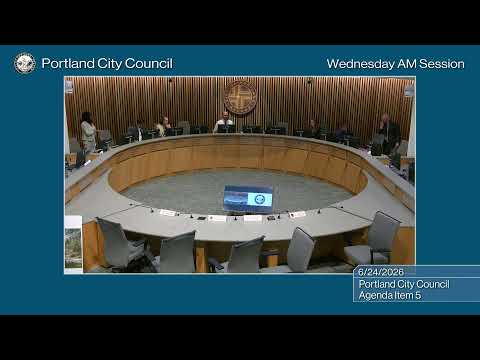
Councilors opened a multiday evidentiary hearing June 24 on the voluntary Lloyd Center Central City Master Plan, fielding lengthy testimony from appellants and dozens of Portlanders who said the plan fails to protect the Lloyd Center ice rink.
The hearing, called by Council President (Dunphy), began with staff from the Portland Permitting and Development Bureau presenting the Design Commission’s findings and the conditions of approval that accompanied the commission’s 5–0 vote to approve the master plan. City planner Benjamin Nielsen said the plan divides the roughly 27.1-acre site into 14 development areas, proposes about 6.2 acres of publicly accessible open space, and includes conditions intended to ensure public access easements and phased infrastructure delivery. He told council the options were to deny the appeals and adopt revised findings, deny and uphold the decision, or grant one or both appeals to overturn the commission’s approval.
Appellants — represented by attorney Jeff Kleinman for the Save Lloyd Ice Coalition and including organizers Jenny Gilmore Robinson and Matt Henderson — asked council to remand the matter to the Design Commission or to make approval contingent on a binding requirement that the developer preserve, replace or relocate a year‑round ice rink. Kleinman argued the Design Commission failed to meaningfully apply Central City 2035 policies and specific design guidelines addressing community building, public spaces, and reuse. The appellants emphasized that the rink is the city’s only year‑round, transit‑accessible facility for learn‑to‑skate programs and affordable public lessons.
Dozens of public commenters gave 90‑second statements describing the rink’s role as an affordable, transit‑accessible community space that serves children, seniors, LGBTQ and adaptive skaters, coaches and small businesses. Speakers repeatedly said they had been led to expect an indoor rink would remain in redevelopment materials and public presentations until shortly before the February Design Commission hearing, and that the sudden exclusion of an ice facility left the community little time to identify alternatives. Testimony flagged environmental concerns about demolition waste and embodied carbon, questioned whether adaptive reuse had been adequately evaluated, and urged the council to demand clearer findings and a credible plan to ensure continuity of skating programs.
Design Commission Chair Sandra Robinson (testifying on behalf of the commission) told council the commission had carefully considered hundreds of written submissions and hours of testimony and had adopted conditions intended to secure public access to proposed open spaces. She also noted the commission’s limited legal authority: it evaluates design and code criteria but does not have the power to prohibit demolition of a non‑designated historic building.
Councilors disclosed ex parte contacts and site visits throughout the morning; Councilor Koyama Lane recused herself. With roughly 140 people signed up on both sides, council President Dunphy said the hearing would continue into the next day if necessary. At the close of the day’s scheduled testimony, Dunphy recessed the hearing and set a continuation for June 25 at 2:00 p.m.; the written record remains open until council moves to close it.
Next steps: council will hear remaining testimony on June 25, and may either issue tentative votes with dates for final findings or remand the plan to the Design Commission for additional analysis and conditions. The council must balance design review findings, developer proposals and community demands for a binding solution to maintain year‑round skating access.