Get Full Government Meeting Transcripts, Videos, & Alerts Forever!
Get email alerts on the Public Safety Fire Inspections topic
No spam. Unsubscribe anytime.
Ottumwa council debates fire‑inspection ordinance and fee schedule; lift‑assist charges to be reworked
Summary
Council discussion of Chapter 14 and Resolution 214‑2025 centered on inspection classifications (high/medium/low), the cost and cadence of inspections, and fees to fund an inspector. Council directed staff to rewrite lift‑assist escalation tiers (proposed 4th–6th $100; 7th+ $250) and to return with a revised ordinance and fee schedule.
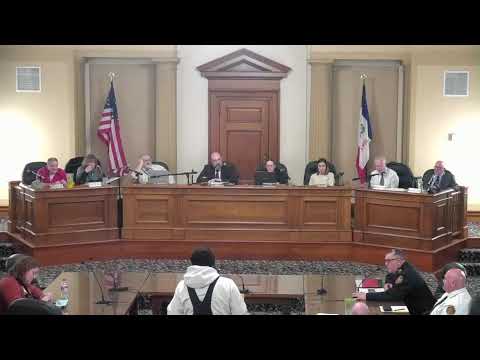
The Ottumwa City Council spent much of its Jan. 28 meeting reviewing a proposed update to Chapter 14 (fire prevention) and a correlated fire‑department fee schedule, focusing on how inspections will be classified, how often they occur, and who pays.
Mayor Foot opened the item by describing a three‑tier occupancy classification (high/medium/low) tied to inspection frequency: high‑risk annually, medium every other year, and low risk every three years, with classifications drawn from the International Fire Code. Fire Chief Mike Canto asked that the ordinance be split from the fee resolution so the inspection policy could be clarified in ordinance language while fees were handled separately.
Chief Canto described using a risk‑based approach consistent with NFPA 1730 and said the fire chief has authority under state law to require inspections. On inspection scope he listed typical items inspectors review—extinguishers, suppression systems, electrical panels and blocked exits—and said staff will publish common inspection mistakes to help businesses comply. “Our intent is not to go out and penalize people. Our intent is to make sure that, you know, the city of Ottumwa and the businesses in the community are fire safe,” Chief Canto said.
Council and staff clarified which code editions apply: staff said the city adopted the 2021 International Fire Code, while some building‑code references still reflect the 2015 edition; staff suggested considering adoption of the 2024 codes later to align provisions.
The meeting also covered fee mechanics. Staff explained administrative charges (billing and accounting functions) and apparatus/personnel cost‑recovery rules (hourly vehicle and personnel rates with a one‑hour minimum). Staff presented demographic estimates showing that most inspections would be $250 or less and that the fee revenue would fund a fire‑inspector position rather than increase the general fund.
A contested element was the “lift assist” fee. Chief Canto said skilled‑nursing and assisted‑living facilities often call for non‑injury lift assists and that the proposed facility fee was $350 per unnecessary call. For residential lift assists staff proposed charging when calls are frequent: initially a free or warning period and then a charge on repeat responses. Councilmembers debated fairness to older residents and to small providers and proposed an escalation that gives early reprieves then increases charges. By discussion the council asked staff to reword the escalation to an approach that would set the 4th–6th repeat calls at $100 each and 7th and above at $250; staff agreed to rewrite that section and return with the ordinance and fee schedule.
Councilmembers and staff also discussed nonprofit exemptions and the tradeoff between fee revenue and relying on general‑fund support. No final ordinance or fee resolution was adopted that night; the council directed staff to redraft the lift‑assist language, finalize clearer fee tables, and return the item for further council consideration at the next meeting cycle.
Next steps: staff will revise the fee resolution and prepare the inspection ordinance for reintroduction; target dates for those follow‑ups were discussed but not finalized.