Get Full Government Meeting Transcripts, Videos, & Alerts Forever!
Get email alerts on the Utility Rates topic
No spam. Unsubscribe anytime.
PFM adviser tells Polk City to raise water and sewer rates to cover regional expansion, Rock Creek debt
Summary
PFM municipal adviser Matt Stuple recommended Polk City adopt a phased water-rate increase (7% and 12% components) and a 5.5% sewer-rate increase to preserve liquidity and meet upcoming regional capital costs tied to Central Iowa Waterworks and trunk-sewer projects.
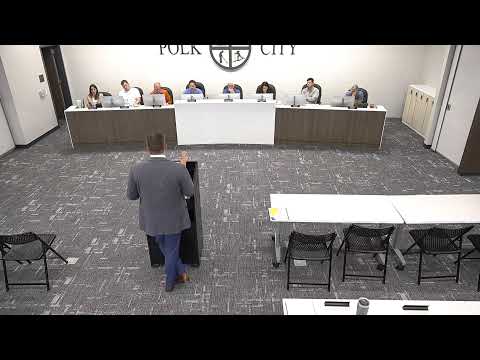
Matt Stuple, municipal adviser with PFM, told Polk City council members in a June work session that the city should approve staged increases to water and sewer rates to shore up reserves and cover its share of significant regional capital projects.
Stuple recommended "a 7 and 12% increase" for water and a 5.5% increase for sewer, saying those steps preserve the city's ability to borrow for projects while avoiding larger, more disruptive hikes later. He said Polk City's utilities are currently in "relatively good financial condition" but face "a lot of capital needs" locally and as part of regional expansions.
Why it matters: Polk City is a member of Central Iowa Waterworks and the regional wastewater authority (RA). Stuple said the city faces both immediate local costs (recent water-tower work, local distribution repairs) and future regional obligations tied to multi-hundred-million-dollar expansions. He warned that, without phased increases, Polk City could face much larger spikes later when new regional debt service comes due.
Details of the water recommendation: Stuple explained Central Iowa Waterworks bills participating cities with a variable purchase price and a fixed charge tied to each community's five-year max-day demand. He cited the regional purchase price of $2.39 per 1,000 gallons and a fixed component of about $226,348 per million gallons (a five-year average-based charge) as drivers of future rate pressure. Stuple said Polk City's recommended water-rate change keeps an existing irrigation premium in place while smoothing domestic-rate increases; the modeled average domestic water bill in the proposal was about $49.58 for 4,100 gallons.
On irrigation pricing, Stuple said the premium on irrigation water can be justified in a wide range depending on how much irrigation volume the city sells, and provided a modeling range "between 156% and 214%" of domestic rates as defensible depending on sales volumes and policy choices. He and council members discussed tiered approaches and the alternative of a small availability fee for irrigation meters (for example, a nominal monthly charge per irrigation meter) to stabilize revenue in low-sales years.
Regional expansion and buy-in costs: Stuple walked through Central Iowa Waterworks' planned expansions and Polk City's proportional shares. He estimated Polk City's investment at roughly $2.7 million for one expansion tied to an estimated $160 million project and about $1.7 million for another component of a roughly $418 million expansion. He said additional projects on the 2035 horizon could add materially to Polk City's long-term obligations.
Sewer and the Rock Creek debt: On wastewater, Stuple recommended a 5.5% sewer-rate increase and said Polk City's sewer rates are driven high by a roughly $17 million Rock Creek sewer investment. He said Polk City's annual payment for that obligation is roughly $560,000 paid to Polk County and that payment will continue to weigh on sewer rates until the loan is paid down (the Rock Creek payment window extends toward 2040). Stuple also noted proposed trunk-sewer financing lines (described in the presentation as proposed 2026A and 2029A) that, if taken on without smoothing, could further raise Polk City's RA-related bills.
Modeling, reserves and coverage: Stuple showed modeling assumptions that build in modest annual increases for the RA (examples used: 9% for one year and 5% thereafter) and explained coverage targets (approximately 1.10 times debt-service coverage) and reserve targets (roughly 50–100% of annual O&M). He noted Polk City had roughly $1.8 million in cash in the water fund in the model and cautioned that sustained operating deficits would force larger future increases.
What the council asked and next steps: Council members asked about irrigation-meter counts and whether meter growth is reflected in projections; Stuple said about 30% of existing homes have irrigation but a higher share of new homes appear to be added with irrigation and that meter-data quirks can undercount zero-usage irrigation meters. He suggested staff could return with options, including availability fees, tiered irrigation rates, or revised domestic/irrigation splits to better explain and defend the premium to residents.
The session ended with Stuple's recap of the recommended increases; no formal vote on rates was recorded at the work session, and the chair moved to adjourn the meeting.